Today first lady Michelle Obama made an unannounced visit to Haiti in her first solo trip overseas. She witnessed the devastation caused by the earthquake and met with the president.
Next Michelle Obama went to Mexico City where she plans to work with children. She has been very welcomed thus far and these countries citizens express happiness towards her presence.
http://www.nytimes.com/2010/04/14/world/americas/14firstlady.html?ref=americas
Tuesday, April 13, 2010

Monday, April 12, 2010
Calle 13 Concert in Cuba
This is a little delayed, but I think the article is interesting enough to still take about and asks a more general question about international interaction with the communist country.
On 23 March 201, the popular Puerto Rican reggaeton band Calle 13 performed in Cuba which was, in the words of singer/rapper Residente, held to talk about "sex, religion and politics". This performance included their controversial song "Querido FBI [Dear FBI]"that criticizes the US for its actions in the death of Filiberto Ojeda Rios, a Puerto Rican radical accused of an anti-US heist in Connecticut. Most Cubans enjoyed the show merely for the music, although the political undertones were obvious.
This provoked the angry reaction of many US-Cubans, including Emilio Esteban, who chastized Calle 13 for making ties with the communist country. Others, however, believe that the criticism is uncalled for and Calle 13 should be able to perform for Cuban citizens without creating so much political drama. Other concerts, such as one held by super popular Colombian singer Juanes, have received similar responses.
This raises an interesting question as to how much if any can the international community interact with Cuba, even in non-political terms, without creating tension with the US and its Cuban population? Should this even be taken into consideration?
Saturday, April 10, 2010
The Masters
With one Round left and angel Cabrera at -3. Does the Argentinian stand a chance to take home the Masters at Augusta?
Friday, April 09, 2010
Elian Gonzalez: All Grown Up
Many people remember the incident back in November of 1999 when 9 year-old Elian Gonzalez was found floating in an inner tube near the coast of Florida. There was much controversy over whether the boy should be sent back to Cuba or stay in Miami with relatives. After much drama, US federal agents returned Elian to Havana.
Throughout the years since the incident, Elian has been kept away from foreign media. However, photos have recently been released that show now 16 year-old Elian at a Young Communist Union Conference in Havana. It is said that whether he like it or not, Elian Gonzalez is still a political symbol.
http://www.guardian.co.uk/world/2010/apr/06/elian-gonzalez-cuba-picture
Throughout the years since the incident, Elian has been kept away from foreign media. However, photos have recently been released that show now 16 year-old Elian at a Young Communist Union Conference in Havana. It is said that whether he like it or not, Elian Gonzalez is still a political symbol.
http://www.guardian.co.uk/world/2010/apr/06/elian-gonzalez-cuba-picture
University of Wisconsin cuts ties with Nike
Friday, the University of Wisconsin Badgers ended the agreement licensing with Nike, Inc. In January 2009, two factories in Choloma and San Pedro Sula, Honduras shut down abruptly. The workers have been left unpaid. Though Nike, Inc. subcontracts its work, these companies are responsible for compensation of their employees. University of Wisconsin is the first University to take this step due to workers rights. Nike is expressing disappointment, but student activists on campus are very happy and hope other universities will take their lead.
Colombian Presidential Candidate Has Parkinson's
Colombian presidential candidate Antanas Mockus revealed that he has been diagnosed with Parkinson's disease. He is the Green Party candidate, and has been 2nd in public opinion polls. Mockus says that the disease would not affect his ability to be president, and says that the disease would not affect him that greatly for 12 years, as it is in early stages.
http://www.nytimes.com/aponline/2010/04/09/world/AP-LT-Colombia-Elections.html?_r=1&ref=americas
http://www.nytimes.com/aponline/2010/04/09/world/AP-LT-Colombia-Elections.html?_r=1&ref=americas
Putin Visits Venezuela to Discuss Oil and Arms
Last week Russian Prime Minister Vladimir Putin met in Venezuela with President Hugo Chavez to discuss weapons sales to the Venezuelan military and the possibility of oil ventures and cooperation between Venezuela and Russia in this area. The Russian and Venezuelan governments have always been friendly and this meeting was based on that friendship. Chavez is currently trying for closer relations with Russia in Latin America to neutralize the US influence in the region. Chavez had hoped that the meeting could be used to discuss plans for Russia and Venezuela to cooperate in a plan for nuclear energy in Venezuela, but at the moment it seems relations between the two are not close enough for that. It seems that for the moment their friendship is limited to oil and weapons sales.
Birthrate declines in Latin America
I found an interesting, recent article which states that the birthrate among Latinos fell in 2008. The article claims that a stereotype of Latin American people is that families tend to have too many children. The National Center for Health Statistics (NCHS) released a report which states that the overall birthrate fell in 2008 by almost 2% after reaching its highest point in two decades. The birthrates dropped in nearly all categories, and the most dramatic change was among Hispanics. The birthrate among Hispanic teens hit a historic low. Stephanie Ventura, chief of the reproductive statistics branch at the NCHS, said she wasn't sure about the decline in Latino births; however, she said that many could consider poor economy and loss of jobs.
Read more at: http://ourlatinamerica.blogspot.com/2010/04/study-latino-birth-rate-drops.html
Read more at: http://ourlatinamerica.blogspot.com/2010/04/study-latino-birth-rate-drops.html
Thursday, April 08, 2010
Mudslide may have killed 200 Brazilian slum-dwellers
A mudslide in Rio de Janeiro on Wednesday buried and may have therefore killed 200 Brazilians. The mudslide was triggered by records amounts of rainfall, and the people of this favella, which was built on top of a former landfill, may have lost not only their houses and belongings but also their lives. Brazil's emergency systems are working to rescue those buried and address the issue, although the nation has also downplayed the event to ease concern regarding the 2016 Olympics.
Wednesday, April 07, 2010
Scopolamine: The Real-Life Imperius Curse
Yes, you read that title correctly. Those of you who read Harry Potter know the effects of the Imperius Curse very well: loss of memory; inability to control your actions; extreme susceptibility to outward influence; and all while acting and talking completely normally. Your friends have no clue you're under someone else's control. Pretty scary, right? Now imagine the ramifications of all of those symptoms in our world today: bank accounts cleaned out, people raped and murdered. A recent article on CNN.com enlightens the world about Colombian Devil's Breath, a plant that strikes fear in the hearts of Colombian citizens but is little known in other parts of the world. Scopolamine, which is essentially a date-rape drug on steroids, is derived from Devil's Breath and is responsible for countless Imperius-esque episodes in Colombia. VBS.tv (CNN's source for the article) interviewed a Bogota drug dealer named Demencia Black who explained Scopolamine like this:
For the full stories, see:
CNN (written article)
VBS (2 videos)
Scopolamine is a drug like no other. Nothing can compare. Got me? For example, with this you could be walking right here and suddenly... *poof* [he mimes somebody blowing a powder out of their hand onto another person]... you have your back turned or a girl walking right here and I walk up and I go *poof*. Just like that. With just that flash the person is totally drugged. You wait a minute and when you see it kick in then you know that you own that person... If you exceed the dose, you run the risk of the person dying.With effects like that, Scopolamine has the potential to become one of the most dangerous drugs in the world. It completely takes away your free will. I have to hope that governments everywhere are already in the process of controlling the Colombian Devil's Breath trade, or we may be in a heap of trouble.
For the full stories, see:
CNN (written article)
VBS (2 videos)
Monday, April 05, 2010
Machu Picchu Re-opens
After being closed in February and March of 2010 due to a mudslides and flooding that trapped 4,000 tourists in Agua Calientes, Peru, the Incan ruins of Machu Picchu re-opened this week. The Peruvian government invited Susan Sarandon to help celebrate the re-opening. This will be very helpful to the Peruvian economy, which has suffered greatly without its most popular tourist attraction - the loss was estimated at approximately $185 million by the Tourism Ministry.
Tuesday, March 30, 2010
Colombian Rebels Free Hostage After 12 Years
Today a soldier held hostage in the jungles of Colombia was finally freed. Colombian rebels handed over their hostage, Sergeant Pablo Emilio Moncayo, to a Red Cross team. As this was the second hostage freeing this week, many are hopeful for a deal with the FARC, a powerful rebel force in Colombia. Moncayo, now 32 years old, says, "You have no idea how staggering it is to return to civilization."
Saturday, March 27, 2010
Cuba Outdoes Itself
Cuba, already reputed to produce the best cigars in the world, will be releasing a new cigar in June. It is called Cohiba Bahike and is part of the prestigious Cohiba line. Critics claim that this new cigar will have "a serious bid to become the best cigar in the world."
For more information: CNN
For more information: CNN
Friday, March 26, 2010
Chávez Critic Is Arrested, Then Freed, in Venezuela
This Thursday agents from the Venezuelan military intelligence agency arrested Guillermo Zuloaga, the owner of the TV network Globovision, one of the most influential networks critical of the Chavez government. He was later released but told not to leave the country while an investigation took place. This arrest follows another arrest this week, this time of one of Chavez's political opponents whole stated that he agreed with the Spanish judge who a few weeks ago accused a Venezuelan official of aiding the Basque separatist group ETA and training Colombian leftist guerrillas. The Chavez government has come under a lot of fire lately on issues of freedom of speech, since many feel that Chavez is increasingly trying to restrict any speech critical of him or his administration.
http://www.nytimes.com/2010/03/26/world/americas/26venez.html?ref=americas
Pesticide in Argentina
To go along with our unit theme of land, I found an article about the dangerous use of agrochemicals in Argentina. The article is an interview with Rodolfo Páramo, a retired pediatrician from the central Argentine province of Santa Fe. When he worked in a smal village in 1994, he noticed a high rate of birth defects. When he investigated, he discovered that the cause was the spraying of glyphosate, a toxic herbicide produced by the U.S. company Monsanto. The herbicide is sprayed on fields of soy, which cover 42 million acres in Argentina.
Mechanical crop sprayers called spiders or mosquitoes would spray soy fields and then return to the village spreading harmful chemicals. Some villages got wise and started to prohibit the storage or entry of the "spiders" into a town's perimiter. Paramo says that, of course, this is not the only case of harmful chemicals and refers to another example from India. Our book mentions other examples. Paramo says its hard to deal with because people know about the dangers but they're getting ignored. Soy is an important crop for Argentina, but the protection of life is more important.
Read more at:http://www.lapress.org/articles.asp?art=6089
Mechanical crop sprayers called spiders or mosquitoes would spray soy fields and then return to the village spreading harmful chemicals. Some villages got wise and started to prohibit the storage or entry of the "spiders" into a town's perimiter. Paramo says that, of course, this is not the only case of harmful chemicals and refers to another example from India. Our book mentions other examples. Paramo says its hard to deal with because people know about the dangers but they're getting ignored. Soy is an important crop for Argentina, but the protection of life is more important.
Read more at:http://www.lapress.org/articles.asp?art=6089
Thursday, March 25, 2010
Ecuador Hot Spot for Financial Crimes
Ecuador has become a popular spot for money laundering and other related illegal activities. Money laundering is facilitated by Ecuador's use of the American dollar as well as its weak laws. This money is frequently used to sponsor terrorist activities, making it an even bigger problem. It is comparable to the activities of North Korea, Iran, and Turkmenistan. An increase in Russian bouncers and South Asian and South African cliental in the Ecuadorian nightlife also contribute to concern over laundering. The government currently denies these occurrences, but has been instead addressing drug trafficking problems, increasing army and police forces and severely cracking down.
www.economist.com/world/americas/displaystory.cfm?story_id=15769869&fsrc=rss
Venezuelan TV owner and Chavez critic arrested
We learned in class from the presentation on Venezuela that although the U.S. has problems with Chavez's undemocratic rule of law, the president has made great strides in many areas of social development and the people of Venezuela were shown to be some of the happiest people in the world. However, with a socialist leader who essentially rules as a dictator, there can often be human rights violations in the areas of freedom of speech and the press. Adding to the article below about the anti-Chavez website under fire from the government, earlier today the owner of the only TV channel in Venezuela that remains critical of Chavez was arrested by the government. This spurred outcries of violations against the rights and freedoms of all citizens. Are the great strides Chavez has made in social reform and equality worth the loss of freedom? This issue can compare with the U.S. in the recent health care reform. Some people worry that any loss of freedom or state control whose purpose is to promote equality may also hinder the freedom of the citizens. Is it more important to have a society with an equal distribution of wealth or to have a society in which citizens feel completely free? Is it possible to have both at the same time?
Venezuela's Energy Crisis
Hugo Chavez has extended the Easter holiday in Venezuela by three days (for most Venezuelans, that now means a 7-day break) in an effort to conserve energy. All government and public offices will be closed starting on April 1st. Venezuela's main hydroelectric dam is currently suffering low water levels because of drought, although opposition to Chavez claim that this energy crisis is a result of poor investment and inefficiency. In an effort to combat energy problems, last month Hugo Chavez signed a decree that will increase electricity prices by 75% for all high energy-users (500+ kw/month) that don't reduce their consumption by 10% or more.
Monday, March 22, 2010
City Hall Burning in Argentina
In Baradero, a city about 60 miles north of Buenos Aires, two teenagers on a motorcycle were chased by the police because they were not wearing helmets. Apparently, the riders attempted to flee and died when the motorcycle crashed into a police truck.
This incident led to outrage over the teenagers' deaths. The city's residents directed their anger towards the police and torched the city hall as well as the vehicle registry office.
http://www.nytimes.com/aponline/2010/03/21/world/AP-LT-Argentina-Uprising.html?ref=americas
This incident led to outrage over the teenagers' deaths. The city's residents directed their anger towards the police and torched the city hall as well as the vehicle registry office.
http://www.nytimes.com/aponline/2010/03/21/world/AP-LT-Argentina-Uprising.html?ref=americas
Saturday, March 20, 2010
A Satirical Site Skewers Chávez and Politics
In an atmosphere that has increasingly been marked by fear and the suppression of the media by the government, El Chiguire Bipolar (The Bipolar Capybara), a satirical website in Venezuela, has become a runaway success. The site features satirical and critical material about Venezuelan President Hugo Chavez, the Chavez government, and other Latin American leaders such as Evo Morales of Bolivia and Luiz Inacio Lula da Silva. It also derides the close relationship between Venezuela and Iranian president Mahmoud Ahmadinejad. As a result, the website has come under fire from the Venezuela government as well as Venezuela's other state-controlled media organizations.
Friday, March 19, 2010
Haitian Children Returned
After six weeks of separation, 32 of the 33 Haitian children taken by American missionaries have been returned to their families. Emotions were mixed and questions were raised about why the children were given up in the first place, but at least now they can move on with their lives and put this episode behind them.
Source: CNN
Source: CNN
Brazil Passing Bill to Divide Oil Wealth
A bill has been passed through the lower house of Brazil's Congress to evenly divide oil riches throughout the country. Certain areas in Brazil are very oil rich, especially Rio de Janeiro, and have raked in hundreds of billions of dollars over the years. These oil-producing regions have been very outspoken in their opposition to this bill. It would mean great losses to their regions. In Rio de Janeiro, tens of thousands of people marched in protest to the bill earlier this week.
Many countries in South America face this same issue: select regions are resource-rich, while others have very few natural resources. So far, these resource-rich regions have benefited greatly off these extra profits, without much accountability. However, this bill shows that change may occur, and perhaps equality can occur for the whole nation, and spread to the rest of Latin America.
http://www.nytimes.com/2010/03/18/world/americas/18brazil.html?ref=americas
Many countries in South America face this same issue: select regions are resource-rich, while others have very few natural resources. So far, these resource-rich regions have benefited greatly off these extra profits, without much accountability. However, this bill shows that change may occur, and perhaps equality can occur for the whole nation, and spread to the rest of Latin America.
http://www.nytimes.com/2010/03/18/world/americas/18brazil.html?ref=americas
Endangered Turtles' Homes in Trouble
Costa Rica has the Playa Grande, a beach which is the last nesting ground for the endangered leatherback turtles in the East Pacific. However, the government, under President Oscar Arias, is trying to scale down the park. Over the past 15 years, lots were sold behind the nesting grounds but inside the national park. It seems that some people were scammed while others didn't care that they were building in the park. Some people have even started building there houses.
Another problem for these turtles is that long-line fishing boats catch female turtles of the coasts of Peru and Chile, which are both nations with important fishing industries. People are saying that they can't stop the fisherman, so they need to stop the Costa Rican government from selling the land. The turtle population seems to be decreasing with every new year. The problem is that Costa Rica will need to pay the people who own houses in the national park expropriation fees. The government stands to lose as much as US$500 million if they can't allow the people to build their houses. Costa Rica has been known for its stringent environmental policies, but it is in a bind.
I thought that this topic was appropriate for our class section on land. It is nice to see that the govenment has to pay people for their land, instead of just taking it. But let's hope the turtles make it out alright.
link at: http://mytulane.blackboard.com/webapps/portal/frameset.jsp?tab_id=_2_1&url=%2fwebapps%2fblackboard%2fexecute%2flauncher%3ftype%3dCourse%26id%3d_31847_1%26url%3d
Another problem for these turtles is that long-line fishing boats catch female turtles of the coasts of Peru and Chile, which are both nations with important fishing industries. People are saying that they can't stop the fisherman, so they need to stop the Costa Rican government from selling the land. The turtle population seems to be decreasing with every new year. The problem is that Costa Rica will need to pay the people who own houses in the national park expropriation fees. The government stands to lose as much as US$500 million if they can't allow the people to build their houses. Costa Rica has been known for its stringent environmental policies, but it is in a bind.
I thought that this topic was appropriate for our class section on land. It is nice to see that the govenment has to pay people for their land, instead of just taking it. But let's hope the turtles make it out alright.
link at: http://mytulane.blackboard.com/webapps/portal/frameset.jsp?tab_id=_2_1&url=%2fwebapps%2fblackboard%2fexecute%2flauncher%3ftype%3dCourse%26id%3d_31847_1%26url%3d
La Amistad: A Relic of the Brutal Atlantic Slave Trade Joins Cuba and the United States
A non-profit organization has built and launched a replica of the slave ship, La Amistad, which is to set sail from New England to the harbor in Havanna in commeration of the famous events that surrounded the ship and its symbolism of the shared slave history of both the US and Cuba. La Amistad was a slave trading vessel whose human cargo mutineed against the crew in 1839 and then sailed the ship all the way to Long Island in New York. Once in the United States their slave status came into question and John Quincey Adams argued the slaves' case before the US Supreme Court, eventually earning their freedom.
The CEO of the non-profit stated that, "We're completely aware of all the issues currently surrounding US and Cuba but we approach this from the point of view that we have this unique history that both societies are connected by. It gives us an opportunity to transcend contempoary issues."
http://www.msnbc.msn.com/id/35933380/ns/world_news-americas/
The CEO of the non-profit stated that, "We're completely aware of all the issues currently surrounding US and Cuba but we approach this from the point of view that we have this unique history that both societies are connected by. It gives us an opportunity to transcend contempoary issues."
http://www.msnbc.msn.com/id/35933380/ns/world_news-americas/
Thursday, March 18, 2010
Cuba cutting back on US food imports
Cuba cut its imports of U.S. agricultural products by 26% in 2009. While some have speculated that this is only Cuba trying to get back at the U.S. embargo, it is actually probably a result of Cuba's lack of economic means. Lower-quality food imports are cheaper from Vietnam, China and Spain because of the rules of trade. The U.S. agriculture industry has been pressuring the U.S. government for a lift on the embargo for a long time as it will allow for freer and more productive trade. Cuba continues to suffer from the embargo; in the first nine months of last year trade fell 36%. I thought this article was relevant after our discussion about U.S.-Cuban relations.
Poem by Edwidge Danticat
Here is a poem by Edwidge Danticat, author of Breath, Eyes, Memory. Since we have been hearing about Haiti so much in the news, I am adding this post so we can all see another aspect of Haitian culture. This poem is very melancholy, but is an interesting depiction of the relationship between Haitians and tourists.
Tourist
Tourist, don’t take my picture
Don’t take my picture, tourist
I’m too ugly
Too dirty
Too skinny
Don’t take my picture, white man
Mr. Eastman won’t be happy
I’m too ugly
Your camera will break
I’m too dirty
Too black
Whites like you won’t be content
I’m too ugly
I’m gonna crack your Kodak
Don’t take my picture, tourist
Leave me be, white man
Don’t take a picture of my burro
My burro’s load’s too heavy
And he’s too small
And he has no food here
Don’t take a picture of my animal
Tourist, don’t take a picture of the house
My house is of straw
Don’t take a picture of my hut
My hut’s made of earth
The house already smashed up
Go shoot a picture of the Palace
Or the Bicentennial grounds
Don’t take a picture of my garden
I have no plow
No truck
No tractor
Don’t take a picture of my tree
Tourist, I’m barefoot
My clothes are torn as well
Poor people don’t look at whites
But look at my hair, tourist
Your Kodak’s not used to my color
Your barber’s not used to my hair
Tourist, don’t take my picture
You don’t understand my position
You don’t understand anything
About my business, tourist
“Gimme fie cents”
And then, be on your way, tourist.
Tuesday, March 16, 2010
Vulnerable Women in Haiti Have No Protection
In Haiti, even before the earthquake, rape was a problem that women faced. Although many women have become presidents of Latin American countries or have achieved high political status, women are sadly abused mentally, physically, and sexually. This can start at a young age in Haiti when women are sent to be restaveks in homes of upper class families where they are often sexually abused by their "fathers."
Since the earthquake, many women and children have been left without homes or families and are left to fend for themselves in tent cities. In these vulnerable cities, they run the risk of being beaten and raped because they lack the protection that their fathers, brothers, and sons once provided. When women are found alone, they can be attacked by strange men, escaped prisoners, and even police. Afterwards, they can face sexually transmitted disease or pregnancy. These women need protection even from the men who are supposed to be protecting them, so who can they turn to? Hopefully, as UN forces arrive in Port-au-Prince, the situation will get better for the young women who are being affected by these violent crimes.
Be thankful for the safety we have: http://www.comcast.net/articles/news-world-latinamerica/20100316/CB.Haiti.Earthquake/
U.S. Warns of Danger in Haiti
Currently the U.S. State Department has warned against traveling to Haiti because of recent killings and kidnappings since the earthquake.
An update reported that "some kidnap victims have been killed, shot, sexually assaulted, or physically abused."
It is said that Haitian police and U.N. peacemakers are important to maintaining security.
http://www.nytimes.com/aponline/2010/03/16/world/AP-CB-Haiti-Earthquake-US-Warning.html?ref=americas
An update reported that "some kidnap victims have been killed, shot, sexually assaulted, or physically abused."
It is said that Haitian police and U.N. peacemakers are important to maintaining security.
http://www.nytimes.com/aponline/2010/03/16/world/AP-CB-Haiti-Earthquake-US-Warning.html?ref=americas
Monday, March 15, 2010
Brazil May Break US Patent Laws
Brazil has announced that it intends to allow local companies to produce certain items that remain under US patent law. These items include movies, music, pharmaceutical products and chemicals. The World Trade Organization currently supports this decision, as the US has continued to provide subsidies for the American cotton industry illegally. The US and Brazil have declared that they will work on negotiating a deal.
http://www.nj.com/newsflash/index.ssf?/base/business-62/1268677957304660.xml&storylist=technology
http://www.nj.com/newsflash/index.ssf?/base/business-62/1268677957304660.xml&storylist=technology
Drug-Related Violence in Acapulco
Thirteen people - five policemen and eight others - were shot and killed in Acapulco; some of the bodies were found decapitated. This recent outbreak of violence in the Mexican resort town is blamed on the rivaling drug cartels in the country.
Of course, being Spring Break season, this is very frightening for many visitors and will mostly likely have a negative effect on tourism in the city.
This is not the first incident of drug-related violence in Acapulco; in June, 18 people were killed.
Link: http://news.bbc.co.uk/2/hi/americas/8566557.stm
Sunday, March 14, 2010
Venezuela's Chavez: Internet Should Be Regulated
Venezuelan President Hugo Chavez demanded that Venezuela place restrictions on what can and can't be said on the internet. He targeted one website in particular, a popular news site for positions critical of the Chavez government. Chavez has "dealt with" critical media before, and currently has multiple investigations looking into the last remaining anti-Chavez channel on open airwaves.
Friday, March 12, 2010
Brazil's Magic Harvest
Despite the world-wide recession that is currently taking place, Brazil is breaking records with its anticipated harvest this season. As the leading economic country in Latin America, Brazil's perfect storm of, "good production and stable rainfall," is extremely important to the region's continued development.
Source: CNN
Source: CNN
Crackdowns on Baseball Players from the Dominican Republic
Baseball is the most popular sport in the Dominican Republic. And over the years the country has contributed many players to American MLB, including many big name stars. However, recently there has been much concern over the few regulations in the Dominican Republic. There are many bad practices, for example, performance enhancing drugs, age and identity fraud, and rogue sports agents.
The Dominican Republic produced 10 percent of major league players last year. Some people think there needs to be more regulations. Commissioner Bud Selig hired former MLB vice president Sandy Alderson to confront some of these issues. Recently, it was disclosed that the Dominican Summer League had the highest rate of positive drug tests in all baseball. Also teams have given expensive contracts to players who lie about their ages. Alderson is restructuring the MLB office in Santo Domingo, the capital. He says that some people are embarrassed about the state of the irregularities from the Dominican Republic, but they are not sure about how to deter ill practices.
The baseball league is trying to figure out how to verify players' ages and identities without drawing criticism. The MLB has no legal standing in the country, so members cannot enforce any regulations. They can only hope for cooperation. Hopefully Anderson can effect some changes and take any suspicion away from the Dominican Republic. He is trying to keep baseball in a good light; it is America's pastime (and the Dominican Republic's).
Read more at http://www.nytimes.com/2010/03/11/sports/baseball/11dominican.html?ref=americas
The Dominican Republic produced 10 percent of major league players last year. Some people think there needs to be more regulations. Commissioner Bud Selig hired former MLB vice president Sandy Alderson to confront some of these issues. Recently, it was disclosed that the Dominican Summer League had the highest rate of positive drug tests in all baseball. Also teams have given expensive contracts to players who lie about their ages. Alderson is restructuring the MLB office in Santo Domingo, the capital. He says that some people are embarrassed about the state of the irregularities from the Dominican Republic, but they are not sure about how to deter ill practices.
The baseball league is trying to figure out how to verify players' ages and identities without drawing criticism. The MLB has no legal standing in the country, so members cannot enforce any regulations. They can only hope for cooperation. Hopefully Anderson can effect some changes and take any suspicion away from the Dominican Republic. He is trying to keep baseball in a good light; it is America's pastime (and the Dominican Republic's).
Read more at http://www.nytimes.com/2010/03/11/sports/baseball/11dominican.html?ref=americas
The Inauguration of Chile's New President, Sebastian Pinera, Is Interrupted By a 6.9 Magnitude Aftershock
The largest aftershock to occur in the wake of the terrible 8.8 magnitude Chilean earthquake hit the nation on Thursday as Sebastian Pinera was sworn into the Chilean presidency. The Chilean Navy issued a tsunami alert in response to a series of aftershocks that advises coastal dwellers to evacuate to higher ground. There were no reports of damages or injuries in the aftermath (note: this aftershock was similar in size to the earthquake that devastated Haiti).
http://www.msnbc.msn.com/id/35815392/ns/world_news-chile_earthquake/
http://www.msnbc.msn.com/id/35815392/ns/world_news-chile_earthquake/
Thursday, March 11, 2010
Mexican man named world's richest person
A Mexican man was named as the world’s richest person by Forbes magazine, surpassing even Bill Gates and Warren Buffet. This businessman, Carlos Slim, is the first person from a developing country to be named as the wealthiest person on earth. This is an important step in demonstrating the great advances in economic growth in developing countries of Latin America, but it also shows the huge poverty gap that still exists in the region. While some Mexicans are proud of Slim’s achievement, many citizens are actually upset with the naming because of the immense amount of poverty that remains in the region. In a way, the naming of Carlos Slim as the world’s richest person only demonstrates the social inequality and practice of exploitation of the poor majority by the elite minority in Latin America, a practice whose roots lie in colonialism.
Eye-Witness Account of the Chilean Earthquake
Here is the update on my cousin Connor. His initial reaction was only to my aunt feel better. Here's what happened:
Despite the severity of Chile's most recent disaster, I had no idea of the seriousness of what had just happened that morning. Friday night I was out with friends at a party and around 3 am we left to go to a discoteca. We were outside haggling the prices to get in when the floor started to rumble-- we all initially thought it was just the bass from the music, but figured out pretty quickly what was going on when we looked and saw the windows and umbrellas of the restaurant across the patio shaking violently too. We turned back around to a wave of about 200 people rushing out of the one exit of the club with the sound of tiles and glass crashing to the ground behind them.
A friend of mine and I sprinted down the broken escalator, moving from side to side with everything else, got to the bottom and found somewhere that seemed safe to sit down. The earthquake lasted for a full 3 minutes, and I cannot think of a longer 3 minutes in my life. It started with a small rumble and very quickly escalated to full-scale chaos, and for about 30 seconds it definitely felt like the world was coming to an end.
I haven't been witness to many natural disasters-- the worst I'd lived through were a couple hurricanes and some ice storms-- so I can't say much for tornadoes or tsunamis, but I'm pretty sure an earthquake is just about the worst kind of disaster a person can experience. It is a terrible feeling of hopelessness, like on an airplane when the turbulence hits hard and for just a split second you are sure the plane is going down. An earthquake, especially an 8.8 earthquake, is like the worst kind of turbulence hitting everything that is supposed to be solid, safe and concrete, and it feels like it will never end.
Amazingly, since the walls of the mall we were near didn't fall down, the ground didn't split in half and the roofs didn't cave in, we were all left with the impression that it hadn't been as bad as it felt. I was actually surprised in the morning when the metro wasn't running. Santiago, at least where we were, seemed to have held up as if the earth beneath it had never moved an inch, so as far as we were concerned the rest of Chile must have been okay too.
It took until Saturday evening when we went to a family member's house whose electricity was running for me to realize the true extent of the damage. Santiago, whose older and poorer parts were destroyed, looks as good as new compared to pretty much everywhere south of here. Curicó and Talca, towns where I have a bunch of friends, were left with city centers and plazas filled with the rubble that used to be banks, government offices, stores and adobe houses. Concepción, a hugely important port and the second biggest city in Chile was essentially flattened by almost the epicenter of the quake, followed by about a 40 foot tsunami wave. Concepción's smaller neighboring towns were hit by the same tsunami and in Talcahuano it carried a huge fishing boat 400 meters into town, razing everything in its path. The aftershocks have come strong as well, (there was actually one just now as I write this) and in the two days following the initial quake there were over 90 of them, most of which over 5.0 and the strongest of which was about 7.0-- as strong as the disastrous main Haiti earthquake last month. It was only thanks to strict building codes that the majority of Chile was not leveled.
In the rest of his update, he explains that many people are still in need. Two good ways to help out are to send boxes of toiletries to the Red Cross or to send money.
Also, another earthquake hit today. This one was 7.2.
Wednesday, March 10, 2010
The end of the Paridinha
The move known as the paridinha or little stop could come to end at the World Cup this year. A Brazilian soccer move in which the shooter of a penalty shot stops his motion to throw off the goalies timing has been ruled unsportsmanlike and efforts are being made to make sure it is illegal before the World Cup
Controversy as Cuba Pays for Sex Changes
Mariela Castro, daughter of Cuban president Raul Castro, is a top gay-rights activist who runs the National Sexual Education Center. This organization has worked hard to influence the government and achieved the lift of the ban on sex-change operations in 2008. Mariela continues to fight for the formal recognition of transsexuals in Cuba. She says others "don't know what a person who is trannsexual suffers. It's a prison you can't get out of."
Now the Cuban government pays for a few sex-change operations every year. Some of the controversy over this fact has stemmed from religious beliefs, although Cuba is officially atheist. Another source of controversy is the presence of homophobia in the Cuban culture. Some Cubans remain shocked or outraged that the government would allow these operations, much less pay for them. However, the main controversy comes from the fact that Cuba has limited resources and many citizens feel sex-changes should not be a goverment expense.
While there are diagreements about the government's involvement, it is apparent that Cuba is moving on from come of its old ways. Former President Fidel Castro said, "I'd like to think that discrimination against homosexuals is a problem that's being overcome. Old prejudices and narrowmindedness will increasingly be things of the past."
http://www.nytimes.com/aponline/2010/03/10/world/AP-CB-Cuba-Sex-Changes.html?ref=americas
Now the Cuban government pays for a few sex-change operations every year. Some of the controversy over this fact has stemmed from religious beliefs, although Cuba is officially atheist. Another source of controversy is the presence of homophobia in the Cuban culture. Some Cubans remain shocked or outraged that the government would allow these operations, much less pay for them. However, the main controversy comes from the fact that Cuba has limited resources and many citizens feel sex-changes should not be a goverment expense.
While there are diagreements about the government's involvement, it is apparent that Cuba is moving on from come of its old ways. Former President Fidel Castro said, "I'd like to think that discrimination against homosexuals is a problem that's being overcome. Old prejudices and narrowmindedness will increasingly be things of the past."
http://www.nytimes.com/aponline/2010/03/10/world/AP-CB-Cuba-Sex-Changes.html?ref=americas
Tuesday, March 09, 2010
Mexican Food As A UNESCO World Heritage Site?
UNESCO World Heritage Center - which protects and preserves places of cultural, historical, and natural importance - has designated more sites in Mexico (29 of them!) than in any other country in the Americas, including the Historic Center of Mexico City, Chichen-Itza, and the Whale Sanctuary of Vizcaino on the Baja California Peninsula.
Now, the Mexican government is asking UNESCO to recognize its cuisine on its list of "intangible cultural patrimony". Traditional Mexican food, dating back 3,000 years to the Maya civilization, is being argued by some to be just as important to the country's culture as physical landmarks. The U.N. will decide in April or May if UNESCO will accept this proposal.
http://inform.com/culture-and-lifestyle/mexico-asks-unesco-protect-countrys-cuisine-840962a
Puerto Rican Birth Certificates
The governor of Puerto Rico, Luis Fortuño, passed a law at the end of last year that voided all Puerto Rican birth certificates processed before December 2009 due to high rates of identity fraud. Because the island is a commonwealth - basically an organized but unincorporated territory - of the United States, Puerto Rican birth certificates are very valuable for Latin Americans looking to illegally immigrate to the U.S. under a Hispanic name.
For the 4.1 million Puerto Ricans now living in the United States, however, this law has caused problems because their birth certificates are no longer valid, and there was little education given by the U.S. and Puerto Rican governments about this change. Many of these Puerto Ricans are now left wondering how and where they can get new birth certificates.
To read the whole article: http://www.latina.com/lifestyle/news-politics/millions-puerto-rican-birth-certificates-voided
Sunday, March 07, 2010
US Aid in Haiti
Many countries feel like the US interferes with affairs in other countries, but Haitian people fear that the end of US military aid in Haiti will leave them in unrest. Although US troops will be leaving, aid from the UN will be arriving shortly to continue to rebuild the lives and homes of the Haitian people. My friend's mom, who was in Haiti on a mission trip when the earthquake occurred, is going back to Port-au-Prince next month. :)
http://news.yahoo.com/s/ap/20100308/ap_on_re_la_am_ca/cb_haiti_earthquake;_ylt=ApNY5rJSzlj6D25Fe8NkNum3IxIF;_ylu=X3oDMTJwcWRscmg0BGFzc2V0A2FwLzIwMTAwMzA4L2NiX2hhaXRpX2VhcnRocXVha2UEcG9zAzEEc2VjA3luX3BhZ2luYXRlX3N1bW1hcnlfbGlzdARzbGsDYW1lcmljYW50cm9v
Friday, March 05, 2010
Chávez Dismisses Spanish Claim of Rebel Links
Venezuela's president Hugo Chavez denies reclaims that his government has aided the Colombian rebel group FARC and the Basque separatists, ETA, in Spain. A Spanish judge accused the Venezuelan government of setting up a meeting between FARC and ETA in which FARC requested ETA's assistance in the assassination of Colombian officials visiting Spain. The judge has issues arrest warrants for 13 people, including one Spanish born Venezuelan official. Chavez denies the accusations, saying that Venezuela does not support terrorist organizations.
Drought in Potosi Reveals Sunken Town
There has been a serious drought in Potosi, Venezuela. Meteorologists have linked the lack of rain and the drought that followed to El Nino, or a warming of the waters in the Pacific Ocean. The normal weather patterns in the region were interrupted causing the lack of water. The drought has exposed the once submerged town of Potosi. In 1985, a hydro-electric dam was built, and the town was intentionally flooded. The 85 foot church in the town used to have its steeple used as the high water mark for the reservoir. Now, the water level fell 98 feet, revealing all of the church, houses, and even a cemetery. There is a problem: if the water level falls another 10 feet, the dam will no longer be able to produce electricity.
I saw a video about this story. People can now walk through parts of the town. One resident who had lived there 25 years ago said the sight saddened him because it only brought back old, sad memories.
You can check out the story (and see a picture of the falling water line on the church) at http://news.gather.com/viewImage.action?fileId=3096224746252909&articleId=281474978070814
I saw a video about this story. People can now walk through parts of the town. One resident who had lived there 25 years ago said the sight saddened him because it only brought back old, sad memories.
You can check out the story (and see a picture of the falling water line on the church) at http://news.gather.com/viewImage.action?fileId=3096224746252909&articleId=281474978070814
Much Looting After Earthquake in Chile
In the days after the earthquake in Chile, looting occurred throughout the cities and towns affected. People broke into shops and kiosks and stole whatever they could, carrying off with expensive electronics and even ATMs. While most looters were poor, some were also middle class. Chile has great inequality, with the 15th highest Gini index in the world, at 54.9 in 2003. While Chile has made great strides in other areas- their growing economy, relatively low and continually dropping poverty rate, and big foreign investment, this does not seem to be good enough. These strides have not been sufficient, as people scrounged for whatever they could during the period of chaos after the earthquake hit.
http://www.washingtonpost.com/wp-dyn/content/article/2010/03/03/AR2010030304595.html?sid=ST2010030304491
http://www.washingtonpost.com/wp-dyn/content/article/2010/03/03/AR2010030304595.html?sid=ST2010030304491
Thursday, March 04, 2010
Mexicans celebrate same-sex marriage
In January I wrote a post about Mexico City's new law legalizing gay marriage. Today hundreds of couples registered for licenses, and the first weddings will take place within the next week or so. This is a huge step for Latin America as it is the region's first same-sex marriage law. Political leaders and activists supporting the law hope it will set an example for the rest of the region.
http://news.yahoo.com/s/ap/20100304/ap_on_re_la_am_ca/lt_mexico_gay_marriage
http://news.yahoo.com/s/ap/20100304/ap_on_re_la_am_ca/lt_mexico_gay_marriage
Monday, March 01, 2010
No Third Term for Colombian President Uribe
The President of Colombia, Alvaro Uribe, has become quite popular during his eight years in power. He has done very much in the campaign against guerrilla forces and is one of the United States' strongest allies in Latin America.
Despite his success, Uribe has been denied to run for a third consecutive term. The Constitutional Court remains loyal to the constitution's limit of two presidential terms. Uribe comments, "I accept and respect the decision of the Constitutional Court."
Many Colombians believe Uribe's policies have gotten the country onto the right track and potential presidential candidates are likely to continue his policies and plans.
http://www.nytimes.com/2010/02/27/world/americas/27colombia.html?ref=americas
Despite his success, Uribe has been denied to run for a third consecutive term. The Constitutional Court remains loyal to the constitution's limit of two presidential terms. Uribe comments, "I accept and respect the decision of the Constitutional Court."
Many Colombians believe Uribe's policies have gotten the country onto the right track and potential presidential candidates are likely to continue his policies and plans.
http://www.nytimes.com/2010/02/27/world/americas/27colombia.html?ref=americas
It's a Miracle
Dad and daughter fall 13 floors with nothing more than cuts and scrapes:
http://news.yahoo.com/s/ap/lt_chile_survivor_s_story
Sunday, February 28, 2010
Chilean Earthquake
My cousin, Connor, has been studying abroad in Chile this past year before he starts college next fall. He is currently living with a host family in Santiago. When we heard about the earthquake, our family was of course nervous for him. I am happy to report that he is safe. He apparently told my aunt he "didn't think it was that bad." They are living without power at the moment, but otherwise are fine.
This initial response is quite different that what is being reported on the news, but I'm glad he's safe. I am standing by waiting for his first-hand updates.
Clinton Heading to Latin America After Quake
The major earthquake that hit Chile Monday night happened to coincide with a planned tour of Latin America by Secretary of State Clinton who orginally was seeking to build support for tougher sanctions against Iran and one of her stops did include Santiago. However, she will aslo use her stops now as opportunities to reiterate the Obama administration's support for Chile during its disaster and promises of disaster relief and rescue operations.
http://www.msnbc.msn.com/id/35631179/ns/politics/
http://www.msnbc.msn.com/id/35631179/ns/politics/
Earthquake America
In order to understand periods of human history, time is marked by specific landmark moments: the stone age; the rennaissance; the age of technology. Well, many people are saying that we are living in the age of natural disasters. Hurricanes, tsunamis, and massive tornadoes are ripping apart countries all over the world. As most know, Haiti was hit by a 7.0 earthquake earlier this year. On Saturday morning an 8.8 strength earthquake struck Chile. This earthquake, 700 to 800 times stronger than the one in Haiti, affected more than 2 million people. It caused a residual tsunami which hit Hawaii and is continuing to move its way across the Pacific. We can only hope the destruction stops here.
Source: CNN
Source: CNN
Saturday, February 27, 2010
Latin American Diplomacy
Hillary Clinton, Secretary of State, will be making a trip across Latin America. Her first stop will be in Montevideo to attend the inauguration of the Uruguayan President. The trip hopes to stop doubters who believed the Obama Presidency would continue to not show Latin America proper respect.
Friday, February 26, 2010
US to put agents in Mexican Poice Force
The United States and Mexico have had talks, and have agreed to station US agents in Mexico to help control drug trafficking. Agents will be stationed in Ciudad Juarez, the most violent city in Mexico. They will there to aid in efforts to catch drug cartel leaders and their hit men. They will also be helping to share information collected through informants and intercepted communications. This is a big step, as the US has been reluctant to work with Mexico, largely because they are skeptical that Mexican officials can be trusted with US information.
Thursday, February 25, 2010
Buckling down on piracy
Honestly, when I was living in Paraguay it was pretty nice for my host family, who lived on about $15,000 a year (a family of five, not including me), to be able to buy 5 DVDs for only $1.25. Many of the movies had not come out on DVD in the U.S. but were still available for sale on almost every street corner in the market of Ciudad del Este. I knew that the movies were pirated, but it was hard for me to not enjoy spending time with my host family doing something they could afford.
I lived about ten minutes from Brazil, and we went to Brazil often. I just read an article on Yahoo News about how U.S. Attorney General Eric Holder told an audience in Rio de Janeiro yesterday, Feb. 24, that the U.S. is seeking closer cooperation with Brazil in fighting piracy of intellectual property. I think this is an important step in responding to the effects of globalization and in ensuring security of property ownership on an international level. However, it will be difficult to imagine my Paraguayan family not having the economic means to watch movies as they used to.
I lived about ten minutes from Brazil, and we went to Brazil often. I just read an article on Yahoo News about how U.S. Attorney General Eric Holder told an audience in Rio de Janeiro yesterday, Feb. 24, that the U.S. is seeking closer cooperation with Brazil in fighting piracy of intellectual property. I think this is an important step in responding to the effects of globalization and in ensuring security of property ownership on an international level. However, it will be difficult to imagine my Paraguayan family not having the economic means to watch movies as they used to.
Wednesday, February 24, 2010
Latin American and Caribbean Countries Create Regional Bloc
Latin American and Caribbean countries gathered Tuesday to create a regional bloc. 32 countries attended the summit, where they decided to create an organization to support their own interests, minus the influence of the United States or Canada. Latin America is finally creating a regional organization, which can be compared to efforts such as the European Union and the United African Organization. The countries made only cursory plans, but agreed to meet again in 2011. This is a significant step for Latin America, and it will be interesting to see how it turns out!
You can read the article here.
You can read the article here.
Tuesday, February 23, 2010
Peru Soon to Produce More Cocaine than Colombia?
I found an article that I felt was relevant to our discussion of the coca plant and cocaine production.
Apparently, cocaine eradication policies in Peru are lagging, which could lead to Peru overtaking Colombia in total cocaine output. Colombia's cultivation area of the coca plant is declining while Peru's is growing. Predictions suggest that if Peru does not take action in controlling the growth of coca, it will become the top cocaine producer in the Andean nations within the next ten to fifteen years.
While Colombia and Peru are close in amount of cocaine production, Bolovia remains the third biggest producer of cocaine in South America.
http://www.nytimes.com/reuters/2010/02/23/world/international-us-colombia-peru-drugs.html?_r=1&ref=americas
Apparently, cocaine eradication policies in Peru are lagging, which could lead to Peru overtaking Colombia in total cocaine output. Colombia's cultivation area of the coca plant is declining while Peru's is growing. Predictions suggest that if Peru does not take action in controlling the growth of coca, it will become the top cocaine producer in the Andean nations within the next ten to fifteen years.
While Colombia and Peru are close in amount of cocaine production, Bolovia remains the third biggest producer of cocaine in South America.
http://www.nytimes.com/reuters/2010/02/23/world/international-us-colombia-peru-drugs.html?_r=1&ref=americas
Adoption v. Child Trafficking in Haiti
When the earthquake first hit Haiti, the news showed video of hundreds of children being loaded on buses. Aid groups hoped that the children could be taken to safer areas and then put up for adoption once they left the rubble of the city. The buses ended up being too hot though, making some children sick and those with diarrhea and other illnesses even worse. The aid workers didn't have enough supplies or support and many were feeling helpless as they saw many children so sick.
An AP report from today addresses the situation. The conclusion? Very badly. The article states, "UNICEF estimated 380,000 "orphans" even before the earthquake. The definition is loose, as tens of thousands have at least one living parent." Now after the quake, many more have lost their parents or have been put up for adoption in the hopes of achieving a better life.
The report continues, "Haiti's children have long been a commodity — used for adoption, sex trafficking or as unpaid domestic labor. Adoptions can yield as much as $7,000 in fees — a relative fortune in a country where the per capita yearly wage is under $1,000, Kovats-Bernat said. Haitian officials put it bluntly. 'Adoption is a synonym for trafficking,' said Haiti's immigration director Roland Chavannes." Many are fearful that the disorganization created from the quake has lead to larger numbers of children falling into traffickers' hands. Because of this fear, applications for true adoptions are having trouble being fulfilled and aid groups without proper documentation are being detained.
Source: http://news.yahoo.com/s/ap/20100223/ap_on_re_la_am_ca/cb_haiti_americans_detained;_ylt=ApNhsKuirU3KbxBN0Sj_jZK3IxIF;_ylu=X3oDMTMxbWRjMm1oBGFzc2V0A2FwLzIwMTAwMjIzL2NiX2hhaXRpX2FtZXJpY2Fuc19kZXRhaW5lZARwb3MDOQRzZWMDeW5fcGFnaW5hdGVfc3VtbWFyeV9saXN0BHNsawNoYWl0aWFkb3B0aW8-
Latin American Food Dangers!
Latin America - as we have discussed in class - prides itself on its flavorful, diverse and unique cuisine, but an article in Time magazine also points out ten of some potentially dangerous [although completely avoidable] foods in Latin America and throughout the world.
Ranking as #3, was Jamaica's fruit Ackee - before reading this article I had never seen nor heard of this fruit - which is part of the national dish made with codfish. [If you haven't either, I'd suggest looking it up... they're very pretty.] It is originally from West Africa, but was transported to Jamaica in the 18th century [exchange!] and can lead to vomiting, coma, and even death if eaten before it has ripened, caused by a toxin called hypoglycin. Even when the fruit turns red, the seeds are always poisonous.
Topping the list was hot dogs, but cassava and coffee - both with Latin America connections - were also included.
To read the entire article: http://www.time.com/time/specials/packages/completelist/0,29569,1967235,00.html
Sunday, February 21, 2010
Bolivian Baby Born on an Airplane
Just thought this was funny: Link.
If anyone has seen the movie Where the Heart Is, does this remind you of the Wal-Mart baby?
If anyone has seen the movie Where the Heart Is, does this remind you of the Wal-Mart baby?
Green Efforts in Latin America
The United Nations Economic and Social Commission for Latin America and the Caribbean (ECLAC) has been studying environment issues in Latin America and the Caribbean. The commission issued a report which calls for greater efforts to advance environmentally sustainable development in Latin America. The report is called “Millennium Development Goals: Advances in Environmentally Sustainable Development in Latin America and the Caribbean.” The rate of deforestation in the Latin America is said to be double the global average. The report states that the region’s forest cover decreased by 7 per cent, losing nearly 69 million hectares of forest between 1990 and 2005. Deforestation and degradation of forests causes almost 20 percent of global greenhouse gas emissions; that’s more than all the world’s cars, trucks, ships and planes combined. The UN launched the Reduced Emissions from Deforestation and Forest Degradation (UN-REDD) initiative in 2008 to offer incentives to reverse the trends of deforestation in order to combat climate change.
Also between 1990 and 2005, Latin America has seen an increase of nearly 41 per cent of carbon dioxide emissions from the burning of fossil fuels and cement production. The UN has pledged to achieve eight Millennium Development Goals by 2015, and one of the most important goals is environmental sustainability. The report notes that in the world in the studied years the amount of protected areas grew and consumption of ozone-depleting substances declined. However, this result varies greatly in different geographical areas in different countries; and Latin America is behind.
Many Latin American countries have a lot to worry about, so environment sustainability might not be first on the governments’ lists. But at least the UN is calling attention to problems and providing help for the future.
Source Link.
Also between 1990 and 2005, Latin America has seen an increase of nearly 41 per cent of carbon dioxide emissions from the burning of fossil fuels and cement production. The UN has pledged to achieve eight Millennium Development Goals by 2015, and one of the most important goals is environmental sustainability. The report notes that in the world in the studied years the amount of protected areas grew and consumption of ozone-depleting substances declined. However, this result varies greatly in different geographical areas in different countries; and Latin America is behind.
Many Latin American countries have a lot to worry about, so environment sustainability might not be first on the governments’ lists. But at least the UN is calling attention to problems and providing help for the future.
Source Link.
U.S. Relations With Cuba Remain Tense
After a meeting Friday, February 19th, between the United States and Cuba discussing immigration control, it is clear that the two countries are still having difficulties in maintaining (relatively) friendly relations. In addition to the immigration issue, other topics of discussion included a Havana-jailed U.S. citizen [Alan Gross was arrested in early December 2009 for unauthorized distribution of satellite technology] and a talk between U.S. diplomats and Cuban dissidents [Cuba criticized the United States for "promoting subversion"].
Source: CNN
Source: CNN
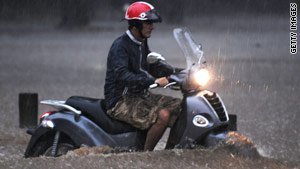
Buenos Aires is Under Water
After the second major storm in a week, Buenos Aires has come to a standstill as the city continues to flood. The subway has been shut down and 60,000 people are without electricity. It remains to be seen if there will be any lasting damage from the storms, but for now, all people can do is push their way through.
 Source: CNN
Source: CNN
Kidnappers In Haiti!
On Thursday, February 18, ten United States citizens were brought up in front of a judge on charges of kidnapping 33 Haitian children after attempting to cross the border into the Dominican Republic on January 29th. They were building an orphanage, and many Haitian parents are reported to have sent their children willingly. Perhaps it was because of this that eight of the 10 would-be kidnappers were released on their own recognizance and allowed to return to the United States. The remaining two, however, remain behind for more questioning.
What will happen?
For more information see CNN World
What will happen?
For more information see CNN World
Saturday, February 20, 2010
Disputes over Foreign Aid to Honduras
Honduran President Porfirio Lobo wants a meeting with President Obama in order to restore ties between Honduras and the U.S. Foreign Minister Mario Canahuati plans to travel to Washington in order to arrange such a meeting. As has been mentioned in previous posts, President Lobo was elected after a coup ousted former President Zelaya. After the Honduran army ousted the president, the U.S. government cut its aid to the country. Now, the U.S. recognizes the legitimacy of the newly elected president, President Lobo (though other nations do not).
However, many critics say that we should not send foreign aid to Honduras because anti-coup activists are still facing human rights violations. Even after the election, there are many reports of human rights abuses. A local leader of the anti-coup National Resistance Front named Julio Funes Benítez was murdered recently. Four members of the civil resistance were kidnapped and held for three days by presumed paramilitary gunmen.
There are other stories of such abuses at
democracynow.org.
Should countries withhold foreign aid until such abuses stop? I dont think we can ever be sure that the abuses have stopped. But countries need to make some kind of a stand.
However, many critics say that we should not send foreign aid to Honduras because anti-coup activists are still facing human rights violations. Even after the election, there are many reports of human rights abuses. A local leader of the anti-coup National Resistance Front named Julio Funes Benítez was murdered recently. Four members of the civil resistance were kidnapped and held for three days by presumed paramilitary gunmen.
There are other stories of such abuses at
democracynow.org.
Should countries withhold foreign aid until such abuses stop? I dont think we can ever be sure that the abuses have stopped. But countries need to make some kind of a stand.
Friday, February 19, 2010
World Cup Recovery
With so much spotlight being put on the World Cup in South Africa, how come not enough focus is on the amazing recovery of Paraguayan player Salvador Cabanas after being shot in the head in a Mexican bar who is now out of the intensive care unit?
Source Link.
Source Link.
Olympics
With no Latin American countries being represented in the Olympic games being held in Vancouver, is anyone from the southern hemisphere even watching the games?
Carnival and Mardi Gras
Since Mardi Gras just happened, I got curious about Brazil's famous Rio Carnival. It was this past weekend, the 13th to the 16th. Like Mardi Gras, it is filled with intricate costumes, balls, bands, parades, and overall general cheer. It would be awesome to visit one day to see it for myself. This website is all about this year's Carnival and is loaded with amazing pictures.
Royal Caribbean in Haiti
I read an interesting article today in the March 2010 issue of Condé Nast TRAVELER, which talked about Royal Caribbean Cruise Line's role in Haiti, particularly after the earthquake.
The cruise line has introduced the largest cruise ship to date, 1,187 feet long and holding up to 6,296 passengers, which has caused some controversy, economically and environmentally. One of its ports-of-call in the Caribbean will include Haiti.
Royal Caribbean actually owns a peninsula in Haiti called Lambadee, which until recently was not advertised to its travelers that it was in fact a part of Haiti - so as not to make them wary of their safety on the cruise. The article says that R.C. "spent $50 million to expand the beach and facilities and to build a pier that would accommodate its new behemoth" (page 46, in case you're curious).
A week after the earthquake, Royal Caribbean was using this port to drop off supplies to Haiti, and has additionally pledged to donate $1 million to the nation. The port is and has been providing jobs for Haitians as well - one employee, with a salary of $300 per month, said that this was ten times more than the average wage in Haiti. And with each passenger of the cruise line that stops at Lambadee, Haiti receives approximately $6.
So, as the articles sums up, "assuming that the money actually does go to the Haitian people, Royal Caribbean will have an even stronger case that sometimes bigger really is better".
U.N. to Review Falklands Dispute
This is a brief article about the Argentine/ British dispute over the Falkland/Malvinas Islands off the souther coast of Argentina. In 1833 the British took control of the islands by force and in 1982 Argentina and Britain fought a brief war over the islands, with Britian coming out victorious. Argentina however has continued to lay claim to the islands and is now disputing a British oil companies attempt to explore for oil off the coast of the islands. Argentina is bring its case before the UN and will demand that Britain abide by General Assembly resolutions.
Group of 7-year-old queen last in Rio Carnival
After the immense controversey that followed the announcement of the child's involvement as drum corps queen, the Viradouro parade group came in dead last on Wednesday in the competition which cancels their participation in Rio de Janeiro's Carnival next year. Instead the Unidos da Tijuca group won for the first time since 1937.
Source Link
Source Link
Thursday, February 18, 2010
Drug War in Ciudad Juarez
The people of Ciudad Juarez, Mexico are fleeing by the thousands due to drug violence in what has become one of the world’s deadliest cities. Over 10 percent of the city’s population has left in the past 18 months from fear caused by the turf war between drug cartels. Ciudad Juarez sits across the Rio Grande from El Paso, Texas, and at least 30,000 have moved to El Paso from this dangerous city. The demand side of the drug trade is a major cause of the Mexican drug war and the conflict it causes, and this demand is mainly based in the U.S. We need to be aware that our choices and policies concerning drugs affect the lives of thousands of Mexican people each day.
Find the full article here.
Find the full article here.
Wednesday, February 17, 2010
A Joyless Carnival Season in Haiti
As we end the festivities of Mardi Gras, we realize that Haiti's usually extravagant Carnival celebration did not occur this year due to the devastation of the earthquake.
The January 12 earthquake hit just as the Carnival season was beginning. The Haitian people have lost so much that they feel no desire to celebrate. "I'm not sad because we don't have Carnival. I'm sad because I lost eight people in my family. They'll never dance again," said a 25-year-old woman.
We should take this sad reality as motivation to continue to reach out to Haiti in the hopes that the people recover physically as well as regain their spirits. It is difficult to speculate whether Haiti will be recovered by Carnival season next year.
Source Link
The January 12 earthquake hit just as the Carnival season was beginning. The Haitian people have lost so much that they feel no desire to celebrate. "I'm not sad because we don't have Carnival. I'm sad because I lost eight people in my family. They'll never dance again," said a 25-year-old woman.
We should take this sad reality as motivation to continue to reach out to Haiti in the hopes that the people recover physically as well as regain their spirits. It is difficult to speculate whether Haiti will be recovered by Carnival season next year.
Source Link
Friday, February 12, 2010
Sarayaku Kichwa Indigenous Group Wins Over Oil Companies
The Ecuadoran indigenous group Sarayaku Kichwa has been fighting for over 14 years to have 2 oil companies removed from their land, and has finally won. The two oil companies, both part of United States companies, have been there since 1996. This violates an agreement giving Sarayaku Kichwa rights to the land. The oil companies have used intimidation to maintain their position.
Sarayaku Kichwa took up this dispute against Ecuador, through the Inter-American Commission on Human Rights, where they finally rules that the government must protect the community first and foremost.
This brings to light the impact of globalization, and the criticism that it is mostly American expansion into other countries. The "McWorld" effect, where America is the dominating element in globalization, can interfere with local communities. Countries need to get their priorities straight before America can entice them with deals; the people must come first.
Here is the article.
Sarayaku Kichwa took up this dispute against Ecuador, through the Inter-American Commission on Human Rights, where they finally rules that the government must protect the community first and foremost.
This brings to light the impact of globalization, and the criticism that it is mostly American expansion into other countries. The "McWorld" effect, where America is the dominating element in globalization, can interfere with local communities. Countries need to get their priorities straight before America can entice them with deals; the people must come first.
Here is the article.
Western Oil Companies Get Contracts from Hugo Chavez
Venezuela nationalized some oil assets in 2008. After some clashes with Easern oil companies, Venezuelan president Hugo Chavez decided to give contracts to Western (mostly American) oil companies. Some Venezuelans were concerned about Western companies' investments and operations. However, Chavez hopes to be able to help his country's now hurting ecomomy and its flagging oil production.
The United States is the largest consumer of Venezuelan oil. The oil companies want to drill in the Orinoco Belt, an area in Venezuela that contains one of the worlds largest recoverable oil reserves. Although many companies bid on the contracts, some American companies declined to bid. This may be because of the politics of Hugo Chavez,or the Venezuelan economic policies.
The article can be found here.
The United States is the largest consumer of Venezuelan oil. The oil companies want to drill in the Orinoco Belt, an area in Venezuela that contains one of the worlds largest recoverable oil reserves. Although many companies bid on the contracts, some American companies declined to bid. This may be because of the politics of Hugo Chavez,or the Venezuelan economic policies.
The article can be found here.
Thursday, February 11, 2010
Si Cuba! on Campus
You may have seen flyers around campus advertising "Si Cuba!" According to the Stone Center website, it is "a major citywide presentation of arts, music, and culture related to Cuba" that will take place from January through the spring of 2010. Our own Newcomb Art Gallery is participating in the collaboration by hosting Polaridad Complementaria: Recent Works from Cuba. I have not yet seen the exhibition, but it will be right on campus until March 4.
This is a great opportunity to take advantage of the University's resources, expand on what we are learning in class and experience a citywide event. If you'd like to be adventuresome and explore off campus, there are events being hosted throughout the city including more exhibitions at the New Orleans Museum of Art. Go to the event's website for more information.
This is a great opportunity to take advantage of the University's resources, expand on what we are learning in class and experience a citywide event. If you'd like to be adventuresome and explore off campus, there are events being hosted throughout the city including more exhibitions at the New Orleans Museum of Art. Go to the event's website for more information.
Wednesday, February 10, 2010
Bolivia's Space Program
It may come as a surprise that the poverty-stricken country of Bolivia has recently developed a space agency. The agency has officially been approved by president Evo Morales. Chinese experts will assist in the creation and launch of the Bolivian Space Agency's first satellite. Construction of the satellite, to be named Tupac Katari, is scheduled to begin in March. This is an exciting development for Bolivia.
Costa Rica elects its first female president
Laura Chinchilla won Costa Rica’s presidential election Sunday, Feb 7. This marks a trend in Latin American politics that involves the increased election of female officials. Other female presidents recently elected in the region include President Michelle Bachelet of Chile who was elected in 2006 and President Cristina Elizabet Fernández de Kirchner of Argentina who was elected the following year. This trend can also be found in overall female representation in the government. The election of women to office may seem contrary to the idea of machisimo, commonly believed to be widespread in Latin America. However, it may also be understood to be the result of the common Latin American belief that women are morally superior to men that goes hand in hand with machisimo. Either way, Chinchilla’s election and the increase in female representation in Latin America is a positive trend for women’s rights that will hopefully inspire nations around the world.
Samba Queen Scandal for Rio's 2010 Carnival
Seeing as it's Mardi Gras season, I figured it would be appropriate to share this news scandal in Latin America's Carnival capital, Rio de Janeiro.
A seven-year-old girl, Julia Lira, was named queen of Viradoura Samba School - a title traditionally given to an older woman because of its sexual overtones. This has caused quite a stir among Brazilians and also the international community and is possibly going to court with the help of children's rights groups. Julia's father sees nothing wrong with her participation and is fighting to keep her in the parade.
A seven-year-old girl, Julia Lira, was named queen of Viradoura Samba School - a title traditionally given to an older woman because of its sexual overtones. This has caused quite a stir among Brazilians and also the international community and is possibly going to court with the help of children's rights groups. Julia's father sees nothing wrong with her participation and is fighting to keep her in the parade.
Saturday, February 06, 2010
Community Frustrated with How Massacre in Juarez Was Responded To
Shootings in Juarez last weekend have escalated tension within Mexico regarding the high death toll. Community members and relatives of the victims have asked that UN peacekeepers be sent to Juarez and that the president resign. They claim the response to this massacre was too slow.
Friday, February 05, 2010
Drug Cartels Go Into the Rehab Business
Recovering addicts have become the latest targets of the Mexican drug cartels as they use the rehab clinics as fronts for selling drugs and coerce the addicts into becoming drug dealers, hitmen, and smugglers. Clinics have additionally become the scenes of massacres as addicts and rehab staff have been killed from everything to resisting the cartels' influence to failure to pay off drug debts.
Ex-Leader of Honduras Says Successor Must Hasten Purge
Ex-President of Honduras, Manuel Zelaya, is criticizing the new President, Porfirio Lobo, for not acting quickly in purging the government of those who organized, allowed, or supported the coup against him. He says that there are still a number of military officers as well as judges in office that plotted against him. Lobo, on the other hand, has larger problems on his hands and is unlikely to hasten in the execution of Zalaya's criticisms. He still has to convince the rest of the world that his new government is legitimate and that he is in fact the rightful president of Honduras. So far, only the USA, Taiwan, and a handful of Latin American nations have recognized his government as legitimate.
Brazil and the Rainforst
I feel like our book and many of the articles we read for class are very anti-American. Authors of these articles usually view American aid as a negative thing because it tends to lead to dependency. So, I found an article where U.S. aid could be a good thing! U.S. aid helps stop deforestation in Brazil.
Violence Against Mexican Human Rights Advocates
Amnesty International asked the Mexican government to protect human rights activists. Some activists are arguing for the rights of indigenous people in Mexico. These activists are receiving death threats, and some have even been murdered. The police are imprisoning activists, and Amnesty International charged that the Mexican government is not doing enough about it. The govenment has to deal with civilians who are sending death threats, and police who are presenting false criminal charges.
More can be found here.
More can be found here.
Thursday, February 04, 2010
Costa Rica Presidential Election: Laura Chinchilla
As we have discussed in class, Latin America has had an impressive number of female heads of state, and it is expected that the results of Costa Rica's presidential election on Sunday will increase this number by one more.
Laura Chinchilla, having served as VP for current president Oscar Arias, will possibly be the first female elected president in Costa Rica. She is socially conservative - specifically in regards to abortion and gay marriage - and won the Nobel Peace Prize in 1987 for her work to end civil wars in Central American countries.
Read more about her here.
Laura Chinchilla, having served as VP for current president Oscar Arias, will possibly be the first female elected president in Costa Rica. She is socially conservative - specifically in regards to abortion and gay marriage - and won the Nobel Peace Prize in 1987 for her work to end civil wars in Central American countries.
Read more about her here.
Tereré Tereré Tereré
In the wake of our discussion about exchange and Latin American foods, I decided to blog about one of my favorite Paraguayan traditions I encountered while studying abroad: drinking Tereré. Tereré refers to the consumption of yerba mate in a specific way. Yerba mate is enjoyed in Bolivia, Paraguay, and parts of Brazil and Argentina. An herb native to Paraguay and reminiscent of tea, it has recently appealed to U.S. corporations like Smoothie King for its natural stimulant effects, antioxidants, and ability to boost metabolism. It is better for you than caffeine because no crash follows the consumption of Yerba Mate, but it provides as much stimulation and increase in alertness as coffee and energy drinks. Its antioxidants are similar to those found in green tea, and the herb has been found to boost your metabolism.
Paraguayans drink tereré at least two or three times a day. They generally sit in a circle outside, on the ground or in porch chairs. One person holds a pitcher of ice water that is often infused with mint or lemon leaves. A “bombilla” (a metal straw with a strainer at the bottom) is placed in a gourd (basically a cup). The yerba mate is then poured on top of the bombilla to rest inside the gourd. The person with the pitches pours water into the gourd and drinks all the water, which has strained to the bottom through the yerba mate, from the gourd through the bombilla. The server then fills the gourd again with water and passes it to the person next to him/her, who drinks all of the water and passes the gourd back to the server. The server pours more water in and passes it to the next person, and así it continues.
Tereré is an acquired taste. I brought an entire set of supplies needed to drink tereré, as well as 10 lbs of yerba mate, back with me from Paraguay (I was surprised I made it through customs!). Some of my American friends have fallen in love with the drink and its effects, while others can’t stand the taste. I personally couldn’t live without it.
Go to GoYerbaMate.com to buy your own supplies and yerba mate. Campesino is my preferred brand, probably because it was the brand generally favored among the Paraguayans I knew. Order the yerba mate with mint leaves for an extra kick. Or just ask for some of my supply!
Paraguayans drink tereré at least two or three times a day. They generally sit in a circle outside, on the ground or in porch chairs. One person holds a pitcher of ice water that is often infused with mint or lemon leaves. A “bombilla” (a metal straw with a strainer at the bottom) is placed in a gourd (basically a cup). The yerba mate is then poured on top of the bombilla to rest inside the gourd. The person with the pitches pours water into the gourd and drinks all the water, which has strained to the bottom through the yerba mate, from the gourd through the bombilla. The server then fills the gourd again with water and passes it to the person next to him/her, who drinks all of the water and passes the gourd back to the server. The server pours more water in and passes it to the next person, and así it continues.
Tereré is an acquired taste. I brought an entire set of supplies needed to drink tereré, as well as 10 lbs of yerba mate, back with me from Paraguay (I was surprised I made it through customs!). Some of my American friends have fallen in love with the drink and its effects, while others can’t stand the taste. I personally couldn’t live without it.
Go to GoYerbaMate.com to buy your own supplies and yerba mate. Campesino is my preferred brand, probably because it was the brand generally favored among the Paraguayans I knew. Order the yerba mate with mint leaves for an extra kick. Or just ask for some of my supply!
Wednesday, February 03, 2010
Soccer Legend Return Home
Roberta Ayala, former captain of the Argentinian National Team, has ended his European playing career and now looks to sign on one of the club teams in his home country. It will be interesting to see which team will sign him and if the legendary defender will give his team an advantage in the Primera Division standings.
Legalizing Marijuana: A New Angle?
Growing up in America over the last decade, we have all heard about the increasing demand to legalize marijuana. Arguments have become increasingly more creative, and fans everywhere rejoiced when the substance was legalized in California "for medical purposes." While the pro-marijuana faction has been gaining momentum, they have lacked a political figure-head to support their campaign. Until now.
Former Mexican foreign minister Jorge Castaneda stated in an interview Tuesday that marijuana should be legalized in both Mexico and the United States. His reason? Mexican drug cartels earn an estimated 60 percent of their profits from marijuana sale. Since the Mexican government declared war on the drug cartels, roughly 17,000 people have been killed, including 900 during January alone. Legalization would flood the market with a new supply, bringing prices down, increasing competition, and cutting off more than half of the money fueling drug-trafficking operations.
Even though Castaneda's statement will not single-handedly change the United States government's stance on marijuana, it is certainly a step in that direction. Only time will tell how the government will react.
Source: CNN
Former Mexican foreign minister Jorge Castaneda stated in an interview Tuesday that marijuana should be legalized in both Mexico and the United States. His reason? Mexican drug cartels earn an estimated 60 percent of their profits from marijuana sale. Since the Mexican government declared war on the drug cartels, roughly 17,000 people have been killed, including 900 during January alone. Legalization would flood the market with a new supply, bringing prices down, increasing competition, and cutting off more than half of the money fueling drug-trafficking operations.
Even though Castaneda's statement will not single-handedly change the United States government's stance on marijuana, it is certainly a step in that direction. Only time will tell how the government will react.
Source: CNN
Monday, February 01, 2010
Gunmen Kill Innocent Teens in Mexico
This past weekend, a group of gunmen in Ciudad Juarez opened fire on a house party, killing 16 teenagers.
Apparently, drug violence has been prevalent in the city for the past three years, and officials believe this shooting reflected the trend. However, there is no evidence that the victims were involved in gangs or drug use.
Recently, federal police vowed to send 2,000 additional officers to patrol Cuidad Juarez. Hopefully, they will now follow through with this and take the situation more seriously.
Apparently, drug violence has been prevalent in the city for the past three years, and officials believe this shooting reflected the trend. However, there is no evidence that the victims were involved in gangs or drug use.
Recently, federal police vowed to send 2,000 additional officers to patrol Cuidad Juarez. Hopefully, they will now follow through with this and take the situation more seriously.
Chocolate Chicken!
Though chocolate chicken may sound nasty to an American, this dish is actually the national dish of Mexico. Chicken mole, or mole poblano, is a very complicated dish that calls for many ingredients. It has a rich history and is very significant in Mexican culture still today. Some of the legends surrounding its origin can be found on this website: MEXonline.
Friday, January 29, 2010
Haitians Start Rebuilding On Their Own
Ignoring the call from the government to hold off on reconstruction for the time being, many Haitians have begun to either rebuild their homes damaged by the earthquake or have begun collecting materials to build new homes on their plots of land in and around Port-au-Prince. The Haitian people are angry at the government which has largely been disabled for the past 2 weeks and its plan to delay reconstruction efforts until proper building codes can be applied and to relocate some families who live on unsafe plots of land. Haitians are jealously protective of their land plots as many have been passed down from generation to generation and many also contain vegetable gardens which are a critical component of many Haitians diet. Here's an article for more information.
Venezuela's Chavez Devalues the Bolivar
Hugo Chavez devalued the bolivar, Venezuela's currency, on January 8th. He has created two exchange rates: one will be for the public sector, at VEB 2.60 (previously at 2.15), while the other "oil dollar", associated more with industry, will be at VEB 4.30. Specifically, the first exchange rate will be applied to food, health, science and technology, retirees, pensioners, family remitences, and the general public sector, among other things. The "oil dollar" will be used for the many industries in Venezuela, as well as telecommunications, electronic services, computers, tobacco and alcohol, as well as many other similar areas.
Chavez says that this is an effort to reduce Venezuela's dependence on oil and to focus on exports instead.
However, the devaluation has been met with great hostility, and the US humanitarian aid has undermined Chavez's accusations of the US as an evil and greedy country.
Chavez has received much critism for his actions and his rule, which has only prompted more censorship -- he closed down several TV stations this past Sunday, with obvious lack of due process. Protests have turned violent, as students came to speak out in the streets.
Here is an article about Chavez devaluing the bolivar: Link.
And here is one discussing the public's recent reaction to Chavez: Link
Chavez says that this is an effort to reduce Venezuela's dependence on oil and to focus on exports instead.
However, the devaluation has been met with great hostility, and the US humanitarian aid has undermined Chavez's accusations of the US as an evil and greedy country.
Chavez has received much critism for his actions and his rule, which has only prompted more censorship -- he closed down several TV stations this past Sunday, with obvious lack of due process. Protests have turned violent, as students came to speak out in the streets.
Here is an article about Chavez devaluing the bolivar: Link.
And here is one discussing the public's recent reaction to Chavez: Link
A Dessert from Latin America
Since we discussed a possible meal together in class this week, I thought I'd share a recipe for flan. It is a very popular Latin American dessert. It is rich and generally made with a caramel sauce. It has become a world-wide favorite and is now popular in places as far as the Philippines and Japan. This is an example of the exchange between cultures we are discussing in class.
Venezuelan Students Clash With Soldiers Over Chavez 'Reforms'
In light of the coup in Honduras several months ago in which President Zelaya was ousted for trying, against the will of the legislature, to extend the power of his presidency by extending the number of terms he could serve, I found this article about Venezuela rather interesting. It would appear that President Hugo Chavez of Venezuela is trying to follow a similar path. He is trying to implement several changes to the constitution, including an amendment allowing him to serve an indefinite number of terms. While many protesters argue that these new executive powers would give Chavez authoritarian rule, it would seem that, unlike in Honduras, Chavez has the support of most Venezuelans in this attempt to extend executive power.
Honduras Gets A New President
After recently reading about Manuel Zelaya's presidential victory in Honduras in 2005, I found an article about the new president's being sworn in. Zelaya was ousted by the military in June of '09. Aparently people thought he was trying to extend his presidency (among many other issues.) On the 27th, new president Porfirio Lobo was sworn in. Zelaya flew to the Dominican Republic, although he said he would return. President Lobo signed amnesty for Zelaya and the orchestraters of the coup. Hopefully President Lobo can lift the nation from political turmoil.
Thursday, January 28, 2010
La Virgen de Guadalupe
I attended a lecture this evening entitled "Guadalupe's Others: Rethinking Marian Devotion in Colonial Mexico" given by Luisa Elena Alcalá of La Universidad Autónoma de Madrid, and I learned a few things about Our Lady of Guadalupe that I found interesting and thought I'd share.
The Virgin of Guadalupe, the iconic image of the Virgin Mary that is so admired in Mexico was popularized in large part because of the way in which she appeared. Unlike many other virgins which were highly esteemed by Catholics, the Virgin of Guadalupe was [as legend has it] not a work of man, but rather appeared on the cloak of a peasant, Juan Diego - that is, a divine and miraculous creation.
Alcalá said that the Church allowed and encouraged the belief in this as it did not contradict any Catholic doctrines and it was a matter of number of believers and time that led to what the Virgin of Guadalupe represents today for Mexico. I think this is interesting in light of what our Global Studies book said about the importance of perception instead of reality in Latin America. It is not necessarily important whether or not the story of the appearance of the virgin on Juan Diego's cloak is true, but rather that it is believed to be true.
Mexico City defends gay marriage
Mexico City's mayor Marcelo Ebrard said today the city will continue to defend its gay marriage laws. The federal Attorney General office filed a challenge with the Supreme Court this week on the premise that the law violates constitutional stances on the family and the protection of children. However, the mayor remains adamant in his stance that the Mexican constitution does not ban gay marriage or the adoption of children by gay couples, and the first same-sex marriages are set to be carried out in early May while the Supreme Court hears the case.
While many Americans don't think to compare Mexican politics to those of the U.S., there is a clear parallel in Mexico City's struggles with gay marriage policy and the struggles occurring in the United States. This is just one example of a huge issue in the U.S. that the Mexican people also find important. What happens in Mexico City could influence future legislation in the U.S.
While many Americans don't think to compare Mexican politics to those of the U.S., there is a clear parallel in Mexico City's struggles with gay marriage policy and the struggles occurring in the United States. This is just one example of a huge issue in the U.S. that the Mexican people also find important. What happens in Mexico City could influence future legislation in the U.S.
Extreme Suffering for Children in Haiti
Although there have been multiple posts about the tragic earthquake situation in Haiti, I can't help but add one that impacted me even further.
Haiti's children make up 45% of the country's population. They "are among the most disoriented and vulnerable survivors of the earthquake." Needless to say, their world is gone. Not only have the surviving Haitian children lost parents, family members, homes, and schools, but some are also suffering from severe injuries and trauma. Many are now stuck on the streets, struggling to survive each day. There are concerns that these children will be taken advantage of for trade or trafficking.
Haiti's first lady, Elisabeth Delatour Preval, says, "The children of Haiti, unless they get help, they will have lost their childhoods, their innocence."
Let us use this as further motivation to take action in assisting the people of Haiti.
Source: New York Times
Haiti's children make up 45% of the country's population. They "are among the most disoriented and vulnerable survivors of the earthquake." Needless to say, their world is gone. Not only have the surviving Haitian children lost parents, family members, homes, and schools, but some are also suffering from severe injuries and trauma. Many are now stuck on the streets, struggling to survive each day. There are concerns that these children will be taken advantage of for trade or trafficking.
Haiti's first lady, Elisabeth Delatour Preval, says, "The children of Haiti, unless they get help, they will have lost their childhoods, their innocence."
Let us use this as further motivation to take action in assisting the people of Haiti.
Source: New York Times
Thursday, January 21, 2010
Pray for Survivors Still Buried Under Rubble in Haiti
It amazes me how many people were affected by the tragic earthquake that struck Haiti over a week ago. Britney Gengel was an American college student volunteering in Haiti feeding the poor when disaster struck. Eight of the students on her trip were found but she, along with four others, are still missing. She was someone from a privileged society who traveled to a poor developing country to help other people and now her family is grieving but hoping for her return on her 20th birthday. Searchers don't give up hope! More people are still alive and buried in Haiti and we hope for all of their immediate rescue and help. Healthy humans can live under rubble for 12 or 13 days in most extreme cases. Today is day 10, let's keep hoping and trying.
Source: CNN
Source: CNN
Tuesday, January 19, 2010
Lack of Organization in Haiti
Anderson Cooper reported about the conditions following the earthquake in Haiti on Larry King Live. His report shows that due to a lack of structure and the proper medical staff and equipment many more lives have been lost and continue to be lost.
Wednesday, January 13, 2010
Haiti
The long-suffering people of Haiti are facing yet another unimaginable natural disaster and the ensuing human crises.
I haven't written anything about this yet because I am so saddened and feel so helpless that writing about it almost seems fruitless. That, and I'm not quite recovered yet from the paralysis I felt upon hearing the news and seeing the massive destruction to the infrastructure of Port-au-Prince and the loss of so many innocent lives.
Haiti is a country that has had a significant presence in my line of work. I have met and befriended numerous Haitians over the years. I have studied Haiti's people and culture. I have had my students study and learn about Haitian life and culture. In fact, this semester my students in one class will be reading Edwige Danticat's first novel, Breath, Eyes, Memory, and will be watching Jonathan Demme's documentary film titled The Agronomist about the great Haitian radio figure, Jean Dominique. In another class, we'll be reading Paul Farmer's Pathology of Power, which features Haiti as an important case study of his thesis of structural violence.
May God bless and be with the Haitian people in this sad, terrible tragedy.
I haven't written anything about this yet because I am so saddened and feel so helpless that writing about it almost seems fruitless. That, and I'm not quite recovered yet from the paralysis I felt upon hearing the news and seeing the massive destruction to the infrastructure of Port-au-Prince and the loss of so many innocent lives.
Haiti is a country that has had a significant presence in my line of work. I have met and befriended numerous Haitians over the years. I have studied Haiti's people and culture. I have had my students study and learn about Haitian life and culture. In fact, this semester my students in one class will be reading Edwige Danticat's first novel, Breath, Eyes, Memory, and will be watching Jonathan Demme's documentary film titled The Agronomist about the great Haitian radio figure, Jean Dominique. In another class, we'll be reading Paul Farmer's Pathology of Power, which features Haiti as an important case study of his thesis of structural violence.
May God bless and be with the Haitian people in this sad, terrible tragedy.
Port-au-Prince Lies in Ruins
Just before 5pm on Tuesday, January 12, Haiti was hit was a massive earthquake. Centered about ten miles southwest of Port-au-Prince, it completely destroyed several government buildings, including the presidential palace. More information can be read in CNN's report: Link
For more information about how you can get involved in the relief effort, go to: Link
To anyone out there who has family or friends in Haiti, my heart goes out to you. Stay strong and know there is at least one stranger who is doing what she can to help.
For more information about how you can get involved in the relief effort, go to: Link
To anyone out there who has family or friends in Haiti, my heart goes out to you. Stay strong and know there is at least one stranger who is doing what she can to help.
Subscribe to:
Posts (Atom)