Wednesday, June 14, 2006
Controversial Gold Mining in Chile
I heard about this when I got a chain letter about a U.S. based company, Barrick Gold Corp., that is planning to excavate gold beneath two Chilean glaciers. Many people are upset because of the very harmful nature of gold mining. The mining process processes large amounts of earth for a relatively small amount of gold. Cyanide is used in the mining process. This is another cause for worry considering any sort of runoff will leave these sources of water and their rivers undrinkable. Here's the article.

Ford and Mexico
It looks like Ford is trying to recoup its losses over the past decade by "investing" in Mexico. [sarcasm] I'm sure they'll pay the workers exactly the same amount they paid American workers [/sarcasm]
In cased anyone cared...
...what president Lula thought about Brazil's performance in the world cup, here you go. Oh Lula
Daryl Hannah Arrested
You may remember Daryl Hannah from the movie LAST-102 recently watched, "At Play in the Fields of the Lord." She played Andy Huben, one of the missionaries. She was arrested along with 16 other protestors in Los Angeles's South Central Urban Garden on Tuesday. The actress and about 25 immigrant farmers and their supporters were campaigning to save the 14-acre fruit and vegetable garden from planned demolition. "I spent the last 23 days down at the South Central farm, which is the largest urban farm in the nation and provides food for hundreds of families," Hannah says. "The subsistence farmers are from one of the poorest communities. This farm should be a model for sustainable urban agriculture. It needs to be replicated, not eradicated." Leonardo DiCaprio and Willie Nelson had also stopped by the garden in the past weeks to show their support. Perhaps Hannah's participation in the movie, "At Play in the Fields of the Lord" influened her to be more aware of land management in the US. She was charged with a misdemeaner.
ECLAC/CEPAL
This is a great resource for facts and figures related not only to Latin American economies, but also demographic and social trends, regional interaction, projections, and development goals. The name of the UN organization is (in English) Economic Commission for Latin America and the Caribbean, and CEPAL is the same but is the acronym in Spanish. There is a wealth of other publications/links as well.
Latin America's year of elections
Many Latin American countries are facing national elections before the end of 2006. One of the key issues is whether there is a regional left-wing trend, and if so, will it continue with the newly elected governments. BBC News has an interesting take on this issue; here is the link if you're interested in reading further.
Top-Rated Cigars
Ever wanted to know more about the best puros in the world? Most are made in Latin America, and are particularly great in Cuba and the D.R. Here is a list (I don't know how legit) of top rated cigars from 2005.
Huipiles: A way of life
Huipiles, Guatemalan textiles, are one of the most beautiful and significant parts of indigenous culture in this country. They have a MAyan legacies and represent one of the few things that are still significantly kept by almost every member of these communities. The process is very long and complex, it takes around six months to weave a huipil. Most are made out of white cotton and the colors are obtained through vegetal, animal or mineral oringin tinctures. There are 3 basic steps to completing them: preparation (threading and dying the cloth), weaving it, and finally embroidiring it. They are of great importance because it holds a great part of their identity and it is also a method of expression. By seeing a huipil we can tell where it comes from since every tribe has its own style. This dates from colonial times since the Spaniards forced them to weave this way in order to be able to recognize the tribe each person belongs to. They are incredibly beautiful and unique. The only problem now is that, now many of them have been forced to stop making what they feel and just started to do what sells the most. However there are several intents to try to avoid this by training the communities and teaching them how to produce more profitable crafts without giving up doing what they like and feel.
The Chicano Movement
The Chicano Movement of several local outbursts of Mexican American activists throughout the United States. Although it is now all seen as a single movement, it was never unified because there were many groups within the movement that had their own goals and ideals that often did not coincide with those of other groups. Some of these were the United Farm Workers Union led by César Chavez, the Land Grant in New Mexico led by Ruiz Tijerana and La Raza Unida Party in Texas led by José Angel Gutierrez.
Part of the movement was the beginning of the militant identity: “Brown and Proud”, in a way imitating the “Black Pride” of African American movements, and also calling themselves Chicanos, a derogatory word previously used to describe those born north of Rio Grande.
Some of the general political goals of the Chicano movement were to eliminate the discrimination and economic disadvantages, to recognize a kinship with Mexico as well as a validity of Mexican American culture, to improve the lives of farm workers, to end segregation of Chicanos and police repression, and the struggle for political representation and self-determination.
Those who were part of the Chicano movement insisted on the inclusion of Chicano students, teachers and studies in the schools and universities. They also fomented a lot of research for Chicano History.
Part of the movement was the beginning of the militant identity: “Brown and Proud”, in a way imitating the “Black Pride” of African American movements, and also calling themselves Chicanos, a derogatory word previously used to describe those born north of Rio Grande.
Some of the general political goals of the Chicano movement were to eliminate the discrimination and economic disadvantages, to recognize a kinship with Mexico as well as a validity of Mexican American culture, to improve the lives of farm workers, to end segregation of Chicanos and police repression, and the struggle for political representation and self-determination.
Those who were part of the Chicano movement insisted on the inclusion of Chicano students, teachers and studies in the schools and universities. They also fomented a lot of research for Chicano History.
U.S. Says Cuba shut off amenities to Mission
Cuba has been denying that it shut off the water and power to the American Mission in Havana. Link.
Brazil Beats Croatia
Brazil won the world Cup in 2002 and is trying to defend its title this year in Germany. They opened up play against Croatia on Tuesday. The Brazilians were victorious 1-0 in their opener. The game exposed some of the Brazilian teams weaknesses and possibly opened the door for an upset. Link .
High School students return to school in Chile
Students in Chile returned after 3 weeks of strike. The goal of the strike was to receive more money for education to improve schools in disrepair. $200 million was conceded by President Michelle Bachelet. Link
Venezuala Using civilians in military reserves
Venezuela is training civilians to participate in the army. Hugo Chavez is implementing the creation of civilian reserve units all over the country. Possible reasons behind this are the fear of ivasion.
Link .
Link .
Interesting fact about Caracas, Venezuela
I thought this was neat since we just learned about Venezuela today... I have been talking to the exchange student my family had in high school tonight and told him we learned about Venezuela and about the barros around Caracas, and he told me something very ironic. According to him, the barros areas are the second most dangerous municipality in the world, in the same city where his area is the richest municipality in Latin America. The west part of the city, the barros, is very poor with a lot of corruption, informal jobs, while the east is very rich with a good life and good cars.
Tuesday, June 13, 2006
Latinos & Latinas in WWII
World War II was a major turning point for U.S. Latinos, changing the worldviews of an entire generation. Many Latino soldiers returned home to find the same discrimination they had left behind; they began questioning a system that held Latinos to a lower status. Many veterans used the G.I. Bill to earn a college education. Latinas who worked in military installations and in other jobs previously denied them also questioned the status quo. Some Mexican citizens were brought in to fill jobs left vacant by departing soldiers. Few lives were left untouched--even those men who were unable to join the fighting forces would never be the same. In the following years, these men and women made astounding civil rights advancements for their people--in school desegregation, in voting rights, in basic civil rights. Powerful organizations grew out of this era, including the G.I. Forum and the Mexican American Legal Defense and Educational Fund. Sadly, the stories of these men and women have been virtually untold, either in the mass media or in scholarly writing. The main problem has been the small numbers of U.S. Latino journalists, scholars and other writers who would document the stories of this generation. This project seeks to capture the stories of these men and women. This project is being organized by the University of Texas at Austin Department of Journalism. Check their stories here.
Diego Rivera
We're going to talk about art soon, so here's a gallery of Diego Rivera's work. It's pretty cool. Check it out.
Madeira dam proposal
Brazilian officials are proposing the construction of a new dam on the largest tributary of the Amazon river. The eight-hundred and fifty people who would be flooded out of their homes are protesting and have formed the Movement of Dam-Affected people. One member of the group says that he was ousted from his last home due to the erection of a new dam and was never compensated. One Bolivian hydrologist has stated that building a dam on these heavily silt-laden waters is ridiculous. And though the government has tantalized environmentalists with promises of special fish spillways, the inroads and dam construction would surely attract new settlers and gas dillers, which would only exacerbate the problem of deforestation. But small group uprisings such as the MDA are promising; I believe it is likely that only through popular uprising will Latin American environmental reform take place.
Here's the link from 'THE ECONOMIST.'
Here's the link from 'THE ECONOMIST.'
Extractive Reserve of the Lower Rio Branco-Rio Jauaperi
Here's a cool link to the Amazonian Association (Associacao Amazonia) webpage, which is seeking to establish a protected area on the Xixuau-Xiparina rivers in Acre, Brazil. The group has been mapping biodiversity and seeking to preserve the indigenous way of life through promoting ecotourism.
Cuba and the US
What will become of the relation between cuba and the united states?
And how will they continue to torture, becuase of politics, the people of cuba and the people that fled to the US that have not been able to return?
The Cuban government cut off electricity to the U.S. diplomatic mission in Havana a week ago, and U.S. requests for power to be restored have gone unanswered. These small actions just make me wonder of the future of this relation between these two countries.
The full story is here.
And how will they continue to torture, becuase of politics, the people of cuba and the people that fled to the US that have not been able to return?
The Cuban government cut off electricity to the U.S. diplomatic mission in Havana a week ago, and U.S. requests for power to be restored have gone unanswered. These small actions just make me wonder of the future of this relation between these two countries.
The full story is here.
SAN ANDRES Y PROVIDENCIA
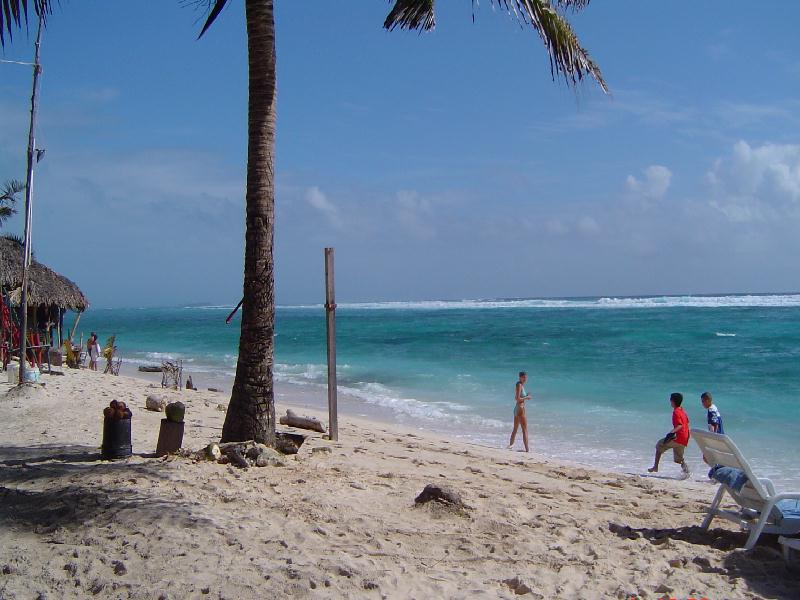

San Andres y Providencia is a small Island which counts towards a part of Colombian territory.
It is located 480 miles North-West of the Colombian mainland in the Caribbean Sea, in close ecological and archaeological contact with the northern part of Colombia, Central America and other islands in the Caribbean. It is made up of the islands of San Andrés, Providence and St. Catherine; Bolívar and Albuquerque islets; Cotton, Haynes, Johnny, Roncador, Serrana, Serranilla, Quitasueño, Rocky, and Crab cays and Alicia and Bajo Nuevo sand banks.
It is a beautiful island that clearly expresses the fusion of various cultures: indigineous, African, Spanish, british and french. They speak a fusion of french, english and Spanish, creating a "Creolle English."
It has an "acuarium," that is actually the ocean itself, where the tourist only uses gogles to discover what is underneath the sea. It is known for its peacful atmosphere and its multicolored ocean.
Subscribe to:
Posts (Atom)