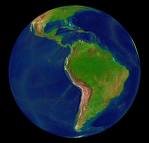
Yesterday was an epic day in Brazilian Stock Market history. Trading was halted for approximately half an hour following the news that the $700 billion bailout plan for American markets had not passed. Before this halt, markets crashed 10.6% and immediately after trading resumed, shares continued to fall, reaching as low as 13%. Mexico's markets went down 6.4% and Argentina's markets went down 8.7%.
This illustrates how definitely the Untied States and Latin America are intertwined. How will Latin America continue to be affected by the economic turmoil of the United States? Read the full article here.
Tuesday, September 30, 2008

Reforestation in Haiti

The Dominican Republic's government is going to give Haiti trees to rebuild the forest on the border of the island that they share. The Dominican Republic has 33 percent of trees on the border while Haiti has a mere 3 percent. The motivation for reforesting the border is that without trees to protect the land, mudslides and flooding have become a greater problem due to the recent hurricanes, leaving the death toll at 426. It is very important that the Dominican government is taking this step, because historically the relationship between the two countries has been hostile. There is still a lot of racism and prejudice towards Haitians in the Dominican today.
The Brief Wondrous Life of Oscar Wao
For my Latin American Studies 101 class we are reading The Brief Wondrous Life of Oscar Wao by Junot Diaz. It is a very interesting book about a Dominican boy growing up in New Jersey. He is a weird kid and has trouble fitting in with his peers but also recieves a lot of grief for not being a good Dominican man because he is not popular with the ladies. It is also a good book if you are interestead in learning about the Trujillo dictatorship and how it impacted the ordinary people in the Dominican Republic.
Monday, September 29, 2008
Sunday, September 28, 2008
New consitution for Ecuador??
It appears that the answer to the above question is yes. Polls on the mainland (not including Galapagos) closed two hours ago, and exit polls show 2 out of 3 Ecuadorians supporting the proposed constitution. In Ecuador, voting is an obligatory civic duty, though "null" is an option, along with "NO" and "SI".
The current version of the Constitution was approved in 1998.
The new proposed Constitution is the idea and project of President Rafael Correa and members of his Constitutional Assembly. Greatest opposition for the proposed constitution comes from Guayaquil, the country's largest city, which lies on the coast. One fear of the opponents is that power will be centralized in the federal government, and that local governments will have less autonomy.
Other changes in the new Constitution:
> no foreign military bases will be allowed in the country (there is currently a US air base in Manta, the only one in South America)
> allows reelection of the President
> the Episcopal and Catholic churches consider that certain parts "open the door to abortion"
> free education (up to university level)
Correa fears the likely bitter opposition he will face from Guayaquil residents. He said that if he lost he would resign, but it looks like this will not be happening.
The current version of the Constitution was approved in 1998.
The new proposed Constitution is the idea and project of President Rafael Correa and members of his Constitutional Assembly. Greatest opposition for the proposed constitution comes from Guayaquil, the country's largest city, which lies on the coast. One fear of the opponents is that power will be centralized in the federal government, and that local governments will have less autonomy.
Other changes in the new Constitution:
> no foreign military bases will be allowed in the country (there is currently a US air base in Manta, the only one in South America)
> allows reelection of the President
> the Episcopal and Catholic churches consider that certain parts "open the door to abortion"
> free education (up to university level)
Correa fears the likely bitter opposition he will face from Guayaquil residents. He said that if he lost he would resign, but it looks like this will not be happening.
Friday, September 26, 2008
Paz Sin Fronteras
When Gray Miles came into class to talk about Colombia, I asked him about the recent conflict between Colombia and Ecuador. Given the persistent fighting, famous Latin singer Juanes, along with a few other artists, held a giant peace concert on the Colombia-Venezuela border called 'Paz Sin Fronteras,' 'Peace Without Borders.' Check out a clip from it below!
http://www.youtube.com/watch?v=jKobA-Jt28E
What do you think this indicates about the citizens of the two nations?
http://www.youtube.com/watch?v=jKobA-Jt28E
What do you think this indicates about the citizens of the two nations?
Unrest in Bolivia
 - picture from Reuters.com
In Bolivia, the poor and indigenous are rioting, setting up roadblocks, and shouting they do not fear death.
A minority group of non-indigenous Whites owns the majority of Bolivian natural resources. President Evo Morales, an Aymara Indian and former coca farmer, came into power because of his promise to redistribute natural gas revenues and farming lands to the indigenous poor. As expected, Morales' policies have angered the wealthy White landowners, who have no intentions of parting with their economic status; but the poor indigenous Bolivians support the president’s policies. To get the word out, and to get on a television program, Morales appeared on the Daily Show:
Daily Show interview w/ Jon Stewart & Evo Morales:
Daily Show interview w/ Jon Stewart & Evo Morales:
State petroleum revenues have increased and private lands have been reallocated, but peace remains elusive in the poorest country south of the Panama Canal. Bolivia is still an underdeveloped “fringe” nation whose neighbors are always eager to take advantage of Bolivia’s natural resources. What improvements have been made since Evo took power? Change never comes easy, see Bolivia's current situation: http://www.reuters.com/news/video?videoId=91210
Guantanamo Prosecutor Quits
A U.S. military prosecutor at Guantanamo Bay has quit because of ethical disputes with his superiors. He said they got rid of evidence that could help clear a young Afghan detainee of war crimes. The prosecutor, described the disagreements in a statement supporting a defense bid to dismiss the charges against Mohammed Jawad. Jawad, who was captured in Afghanistan when he was 16, is accused of throwing a grenade that wounded two U.S. soldiers and their interpreter in December 2002. He faces a maximum life sentence at a trial scheduled to begin in December. Vandeveld said prosecutors knew that Jawad may have been drugged before the attack and that the Afghan Interior Ministry said two other men had confessed to the same crime, according to Michael Berrigan, deputy chief defense counsel for the Guantanamo tribunals. Jawad is one of roughly two dozen Guantanamo detainees facing charges. Military prosecutors say they plan trials for about 200 men held here on suspicion of links to al Qaeda or the Taliban.
Is this part of the reason that many countries, including some in Latin America think that America is an imperialistic country? I thought Americans don't have to worry about human rights...
Venezuelan President Goes on 5-Country Tour
President Hugo Chavez of Venezuela began his tour of five countries last Sunday, with a stop in Cuba where he visited a fragile Fidel Castro, the former Cuban President. Pictures have been released of Chavez being greeted warmly by current Cuban President Raul Castro at the airport in Havana. After meeting up with Fidel that Sunday night, Chavez was off to Beijing. His tour also included stops in Moscow, another Russian city yet to be identified, Portugal, and France. During these meetings he planned to discuss various issues on Europe, the world, and their relationship.
Castro Comments on Obama
Presidential candidate Barack Obama plans to continue the trade embargo with Cuba if he is elected president. However, his attitude towards travel and relations with Cuba are more open. He wants to ease travel restrictions, and make it possible for relatives of Cuban citizens to send their families money from the United States. Fidel Castro commented on the candidate saying that Obama is "the most progressive candidate to the U.S. presidency." Castro then goes on to be more critical of Obama and his support of continuing the trade embargo against Cuba.
For more information, see the New York Times article: "Castro Weighs In On Obama" May 26, 2008
Potential Attempt on Chavez's Life Thwarted
Authorities arrested two in a suspected plot to murder President Hugo Chavez of Venezuela. Venezuela's topmost security official reported Wednesday that the plot was to destroy Chavez's plane with an anti-tank weapon. Six have been apprehended for purportedly being linked to the plot. Read more here.
Seized Memory Stick Gives Names Of 9,000+ FARC Rebels
The guerrila movement in Colombia took another hit this week when a lost memory stick made known the names of over 9,000 rebels to Colombian officials. The memory stick held not only their names, but also their aliases, identity numbers, and photos of some of the rebels. This development is not the only bad thing that has happened to the FARC resistance recently. Colombian government said it has used other technological information to aid in capturing individuals invovled in the resistance. Read more about this recent development here.
Thursday, September 25, 2008
Chile's Sexual Revolution
The New York Times published an article discussing what they label as a sexual revolution in Chile. Under the Pinochet regime sexual education was taken out of schools and was just reimplemented in the 1990s. This means that parents of teenagers now never had formal sexual education so are not teaching it to their children. There is a huge trend of parties that attract teenagers who dance and try to make out with the most people at the party. These parties are advertised to teens on the internet and create a competitive and sexually provocative setting. To read the article click here.
Acai Frenzy
If you've been to Freshens here on campus you probably noticed their new acai smoothie. Acai is a fruit grown in the Amazon which has become increasingly popular in the last couple of years. It has always been a cheap staple in the diet of Brazil, but it is now becoming trendy all over the world because of its nutritious qualities. Acai also has the potential to preserve more of the rainforest because it is something valuable that grows on trees instead of in their place. However, there is a fear that forest will be clear cut to plant "orchards" of acai. Will the family harvesters be replaced by conglomerates?
Wednesday, September 24, 2008
Father loses son to brazil
Four years ago, David Goldman waved goodbye to his wife and mother-in-law and his four year old son, Sean, at a new Jersey airport to wish them well on what was supposed to be a two week family vacation to his wife's native country, Brazil. What he didn't know, was that she had no intention of coming back. Once she got to Brazil, David recieved a call from Bruna, his wife, telling him that she wasn't going to return to the US and that if he ever wanted to see his son Sean again, he would have to give her sole custody. While in Brazil, Bruna married a prominent lawyer from a well-off brazilian family.
David brought his case to the court and it has been in limbo between US custody laws, Brazil custody laws and international laws between the two countries. According to the Hague treaties, which both countries have signed, Sean should have been returned to the US, however, the brazilian courts waited too long to act on anything and decided, as it had been a year, that Sean had been in Brazil too long to take him away from his mother.
Four years later, Bruna died giving birth to her new husband's baby and David thought that after all of the fighting in the courts, that Sean was finally his. Suddenly, Sean's last name was changed, and Goldman was erased from the records. Goldman is now trying to find a way for his Sean's last name to become Goldman again and for his chance to take his son back, but will the Brazilian courts follow their own custody laws that would return Sean to the United States, or will the influential brazilian family prevail? To read more click here
David brought his case to the court and it has been in limbo between US custody laws, Brazil custody laws and international laws between the two countries. According to the Hague treaties, which both countries have signed, Sean should have been returned to the US, however, the brazilian courts waited too long to act on anything and decided, as it had been a year, that Sean had been in Brazil too long to take him away from his mother.
Four years later, Bruna died giving birth to her new husband's baby and David thought that after all of the fighting in the courts, that Sean was finally his. Suddenly, Sean's last name was changed, and Goldman was erased from the records. Goldman is now trying to find a way for his Sean's last name to become Goldman again and for his chance to take his son back, but will the Brazilian courts follow their own custody laws that would return Sean to the United States, or will the influential brazilian family prevail? To read more click here
Caribbean Ravaged by Hurricanes
Four hurricanes have hit the Caribbean and Central America particularly fiercely in the last 30 days. Hurricanes Fay, Gustav, Hanna, and Ike have all left the islands devastated, with a total of 600 dead and 80,000 homeless. Some of the nations affected the most include Cuba, the Dominican Republic, and Haiti, the poorest nation in the Western Hemisphere. With regards to their economic state before, one can only imagine what sort of economic state they are in now. How will these nations and the rest of the world respond to this crisis? Read the news story here.
Tuesday, September 23, 2008
Monday, September 22, 2008
Chile's Sexual Revolution
The New York Times published an article discussing what they label as a sexual revolution in Chile. Under the Pinochet regime sexual education was taken out of schools and was just reimplemented in the 1990s. This means that parents of teenagers now never had formal sexual education so are not teaching it to their children. There is a huge trend of parties that attract teenagers who dance and try to make out with the most people at the party. These parties are advertised to teens on the internet and create a competitive and sexually provocative setting. To read the article click here.
Saturday, September 20, 2008
Friday, September 19, 2008
A Glimpse Into The Lives of Haitian Child Laborers
A recent article in the New York Times highlights the lives of young Haitian child laborers, restaveks. It discusses the impact of the recent hurricanes on the lives of these children, stating that up to 30,000 have been affected by the storms. Many of the restaveks are said to be beaten, sexually abused, denied education, and "treated like animals." The author of the article talks to two 12-year old girls, Widna and Widnise, who say they are treated better than most of the other children in their small town, as they are only "hit on their palms if they are disobedient but do not receive lashings on their head, as they say many of the restaveks in nearby homes receive."
The article shows just a glimpse of the state of affairs in the small island country.
The article shows just a glimpse of the state of affairs in the small island country.
Subscribe to:
Posts (Atom)